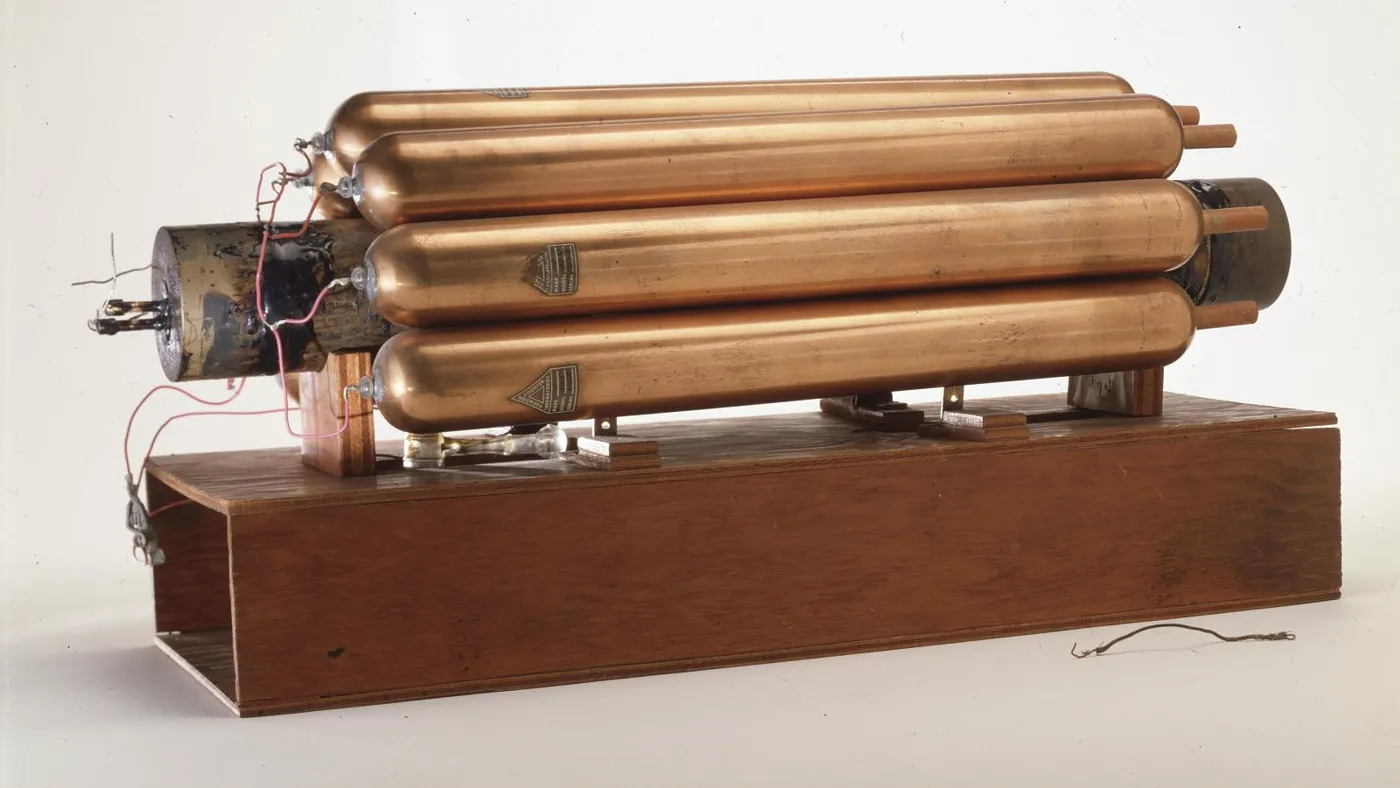
Libby Low Level Counter
It counted the faint radiation from a sample, so scientists could work out how much carbon-14 was left and date it.
- Date
- 1950
- Maker
- Willard F. Libby
- Place
- United Kingdom: England, Cambridge
- Dimensions
- overall: 70 cm x 34 cm x 25 cm; 27 9/16 in x 13 3/8 in x 9 27/32 in; arch of anticoincidence counters: 18.1 cm x 52 cm x 20.4 cm; 7 1/8 in x 20 15/32 in x 8 1/32 in; unattached anticoincidence counters: 5.08 cm x 53 cm x 23 cm; 2 in x 20 7/8 in x 9 1/16 in; screen-wall counter: 15.7 cm x 66.6 cm x 7.77 cm; 6 3/16 in x 26 7/32 in x 3 1/16 in; sliding brass cylinder with carbon: 20 cm x 7.5 cm; 7 7/8 in x 2 15/16 in; sliding brass cylinder without carbon: 20 cm x 7.5 cm; 7 7/8 in x 2 15/16 in; brass connecting cylinder: 8.2 cm x 7.5 cm; 3 7/32 in x 2 15/16 in; plywood base: 16.5 cm x 60.9 cm x 21.4 cm; 6 1/2 in x 23 31/32 in x 8 7/16 in
- Museum
- National Museum of American History
- Credit line
- Gift of Dr. Willard F. Libby
The radiocarbon method of dating materials and objects containing organic carbon has revolutionized archaeology. This is the apparatus which chemist Willard Libby used to show that the complex technique worked.
By the 1940s physicists knew that the element carbon has a radioactive isotope, called carbon-14 because it contains a total of 14 protons and neutrons. They also knew that this isotope has a half-life measured in thousands of years. Next came the discovery that carbon-14 is produced in the atmosphere by bombardment of nitrogen by neutrons produced by cosmic rays. At this point, with this information, Libby began to formulate his ideas about radiocarbon dating, but he was interrupted by World War II and service in the Manhattan Project.
After the war Libby obtained a position at the University of Chicago and set out to prove that his idea would work. His thought was that the radiocarbon in the atmosphere, in the form of carbon dioxide, would be assimilated by plants as they grow. This would mean that all living plants are in fact very sightly radioactive. Furthermore, once they die, they stop taking in the radiocarbon, which gradually decays, reducing the strength of the radioactivity over time. One by one Libby proved these predictions. His biggest challenge was to develop a technique for measuring, accurately, the very weak radiation from his samples of organic material.
This apparatus, dating from around 1947, embodies several of Libby’s ideas for reducing unwanted radiations to a minimum. The basic element is a Geiger-Müller counter containing a sliding cylinder that is coated inside with the sample to be counted, in the form of a thin layer of carbon powder. This cylinder could be slid from a position in which the weak radiation from the carbon was measured, to another position in which it was not measured—but all other sources of radiation, such as contamination in the materials of construction, remained the same. To eliminate the counting of energetic cosmic rays, a set of long, cylindrical counters surrounded the carbon counter. These were arranged as anti-coincidence counters: any cosmic ray that passed through them as well as the carbon counter would be disregarded by the counting circuits. Finally, the entire counting apparatus was enclosed in a massive iron shield (not collected) that blocked the less penetrating cosmic rays.
The result of these painstaking procedures and precautions was an effective method for determining the ages of organic materials thousands of years old. Libby tested the method on samples of wood from Egypt whose age was already known by traditional methods. The scientific community recognized the value of the method immediately, and in 1960 he was awarded the Nobel Prize in chemistry.
The museum's own record (Smithsonian, National Museum of American History)
Also answering “How much?” see all
 Pickett N600-ES Log Log Duplex Slide Rule
 Civil Defense radiation dosage calculator
 Circular Slide Rule, William J. Powell
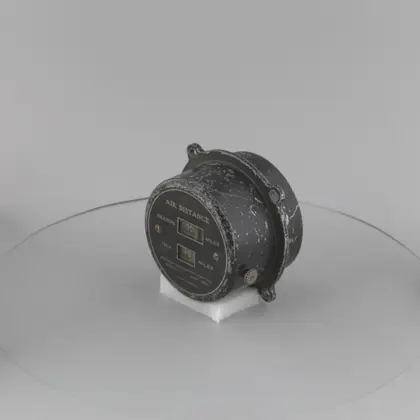 Recorder, Air Distance
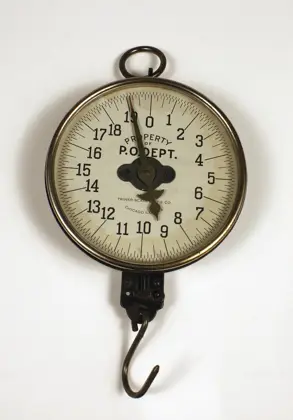 Triner postal scale
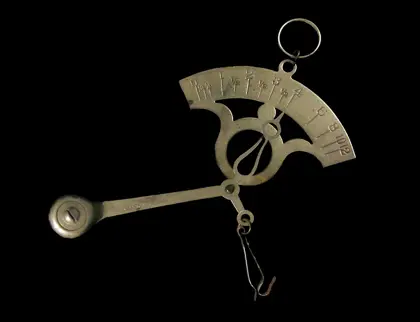 Peerless hanging letter scale
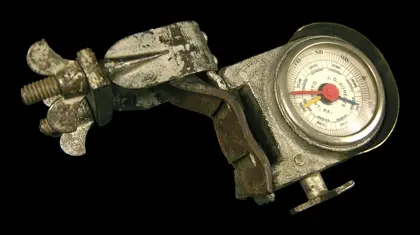 Odometer by J. D. Roberts
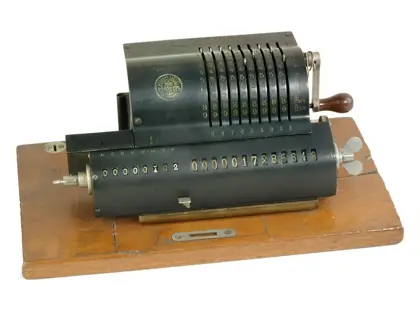 Odhner Arithmometer
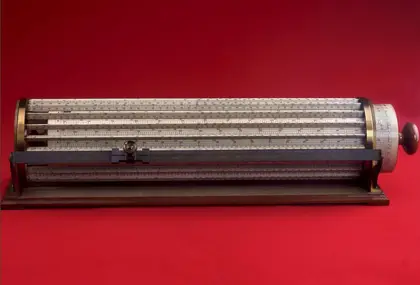 Keuffel & Esser 1741 Thacher Cylindrical Slide Rule
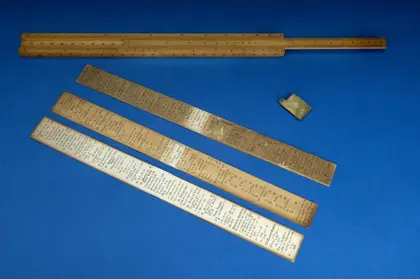 Patent Model for Simplex Slide Rule Clasp Invented by Rudolph C. Smith
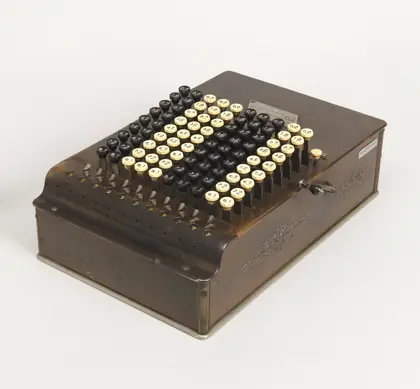 Comptometer
 Log and Rotor, Patent Model