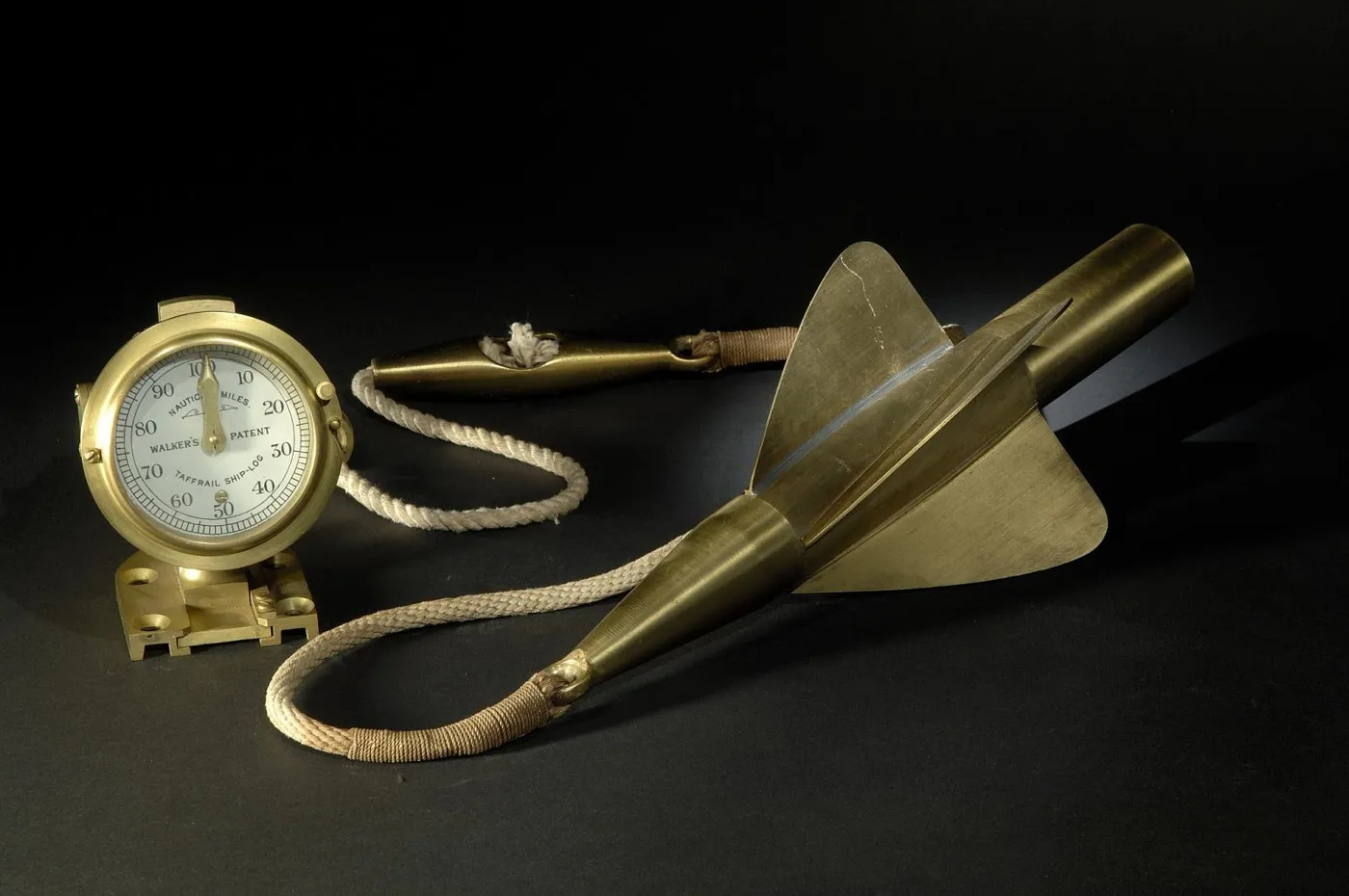
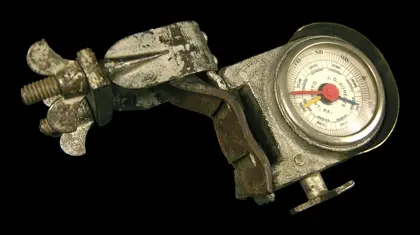
Log and Rotor, Patent Model
A spinning blade towed behind a ship turned a line that moved a dial, showing how far and how fast it had traveled.
- Date
- 1881
- Maker
- Thomas F. Walker
- Dimensions
- overall: 9 1/2 in; 24.13 cm
- Museum
- National Museum of American History
This mechanical log measures a vessel's speed moving though water. The four-bladed rotator is towed astern. As it spins, the rotations of the towing line are registered by a wheel works and dial mounted to the vessel's rail. Older mechanical logs had placed the counting mechanism next to the rotator, requiring the log to be hauled in for reading. In the 1860s American and then English makers began placing the dial in a separate housing on the ship's rail, which allowed readings while the log was in use. Thomas Walker's firm in Birmingham, England, was a leading maker of logs, and he submitted this example, with its special rope connector and numerous internal improvements, to the U.S. Patent Office in 1877.
Speed is an important factor in accurate navigation, and, since the sixteenth century, sailors had determined a vessel's speed using a log. This device was basically a rope with knots tied at intervals along its length. With a board attached to one end to create drag, the log-line would be heaved overboard and allowed to run out for a short period of time. The number of knots counted off indicated the speed. (The unit of speed at sea is therefore the knot, one knot being equal to one nautical mile per hour). Logs were susceptible to a variety of errors, so instrument makers developed mechanical logs to improve the recording of speed and distance.
Thomas Walker (1805-73) was a nephew of Edward Massey, the London nautical instrument maker whose patent mechanical logs enjoyed wide use in the nineteenth century. Walker's firm and Massey's merged at the end of the century. The Walker log seen here was patented in the United Kingdom (British patent no. 4,369, Oct. 30, 1878) before it received similar protection in the United States.
The museum's own record (Smithsonian, National Museum of American History)
Also answering “How much?” see all
 Barbour Calculating Machine
 Baldwin Calculating Engine
 Patent Model for Simplex Slide Rule Clasp Invented by Rudolph C. Smith
 Comptometer
 Baldwin Arithmometer
 Patent Model for Estimator Slide Rule Invented by Fredric Maurice Stapff
 Barbour Calculating Machine Model
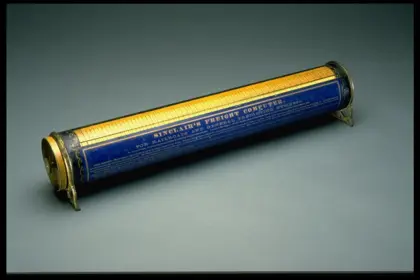 Rotating Mathematical Table, Sinclair's Freight Computer
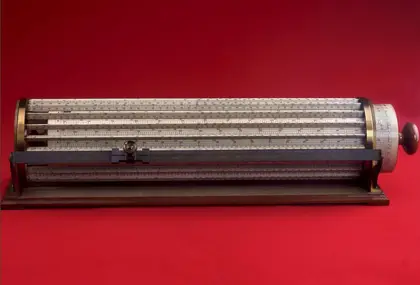 Keuffel & Esser 1741 Thacher Cylindrical Slide Rule
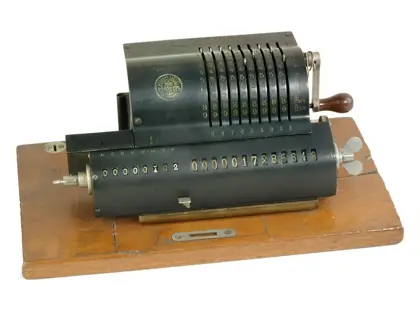 Odhner Arithmometer
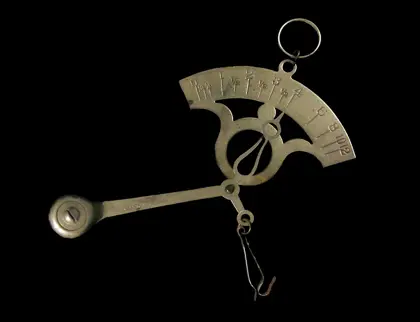 Peerless hanging letter scale
 Odometer by J. D. Roberts