Notes on the records
Reading every record in a collection closely turns up the ordinary edges of any large catalog: a famous name among the people a record lists, a date given only as a range, a record with no description. Here is what this build noticed, with the record quoted each time. A full build would pass notes like these to the collection's staff, who know the objects far better than any reader of the data.
 Worth knowing
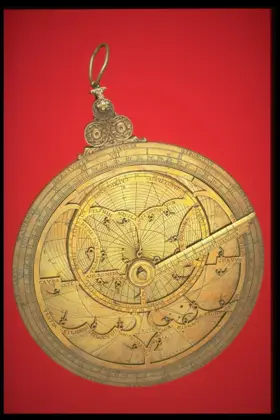
Hartman's Planispheric Astrolabe
The record lists Galileo Galilei as a possible owner, on the strength of an inscription inside the instrument. The astrolabe was made by Georg Hartman in Nuremberg in 1537, and Galileo was born in 1564, so it would have reached him later. A small provenance story sits alongside the maker credit.
The record says: possible owner: "Galilei, Galileo" | maker: "Hartman, Georg" | date made: "1537" | An inscription on the inside of the instrument states that it once belonged to the Italian mathematician and astronomer Galileo Galilei (1564-1642).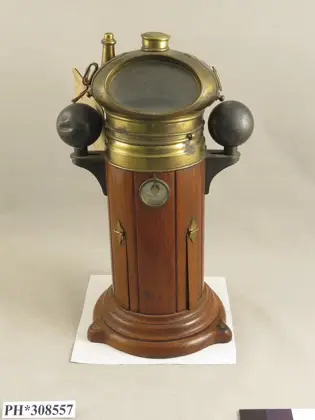 Attribution
Dry Card Compass with Binnacle
The maker field holds the Glasgow firm. The inventor, William Thomson, appears only in the description and the inscription, so a search of the name fields would not find him.
The record says: maker: "J. White" | This is the model that accompanied William Thomson's 1880 application for an American patent for an improved mariner’s compass. | The inscription reads "SIR WM THOMSON’S PATENT. J. WHITE, MAKER GLASGOW."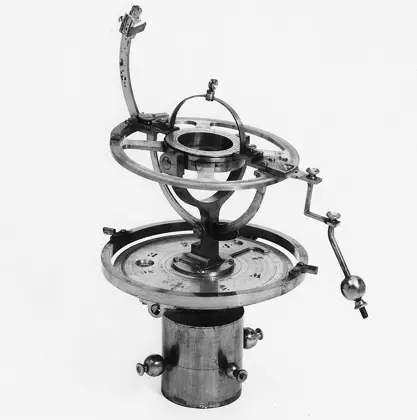 Worth knowing
Solar Compass
The title and the patent name differ, and the inventor is named only in the description. The record's title is "Solar Compass", while the description calls the same patent model a "Mariner's Time Compass" and says Ralph Reeder was the patentee. The maker field lists Henry Ware.
The record says: title: "Solar Compass" | maker: "Henry Ware" | Patent model for Ralph Reeder, "Mariner's Time Compass," U.S. Patent #4,964 (1847).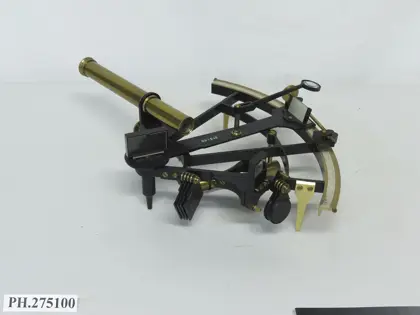 Worth knowing
Sextant
The record names the maker (E. & G. W. Blunt) and separately a user, Mason, a naval officer. The description traces how the sextant probably came to him and then to the Smithsonian through his sister.
The record says: user: "Mason, Theodorus B. M." | maker: "E. & G. W. Blunt" | Theodorus Bailey Myers Mason (1848-1899), a career naval officer, probably acquired this sextant in 1865 when he graduated from the Naval Academy at Newport, R.I. | Mason's sister Cassie (Mrs. Julian) James, a Washington socialite, gave it to the Smithsonian.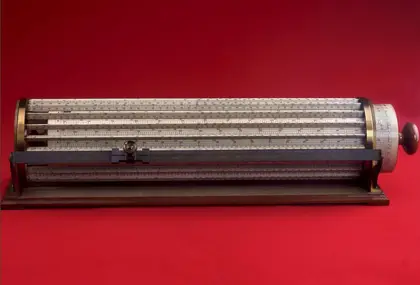 Attribution
Keuffel & Esser 1741 Thacher Cylindrical Slide Rule
Three parties shaped this object: the inventor (Thacher), the London firm that divided the scales (Stanley), and the New York maker. The name fields list Stanley and Keuffel & Esser; Thacher appears in the title and description. The date field says "1890s" while the description names 1887 as the earliest date for this example.
The record says: maker: "Stanley, William Ford" | maker: "Keuffel & Esser Co." | date made: "1890s" | indicating 1887 is the earliest date for this example of the instrument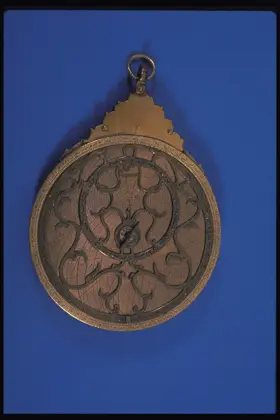 Possible duplicate
Indo-Persian Planispheric Astrolabe
Two different astrolabes share the title "Indo-Persian Planispheric Astrolabe": this one (1643) and nmah_997136 (1659), both made in Lahore. Only the date and the record number tell them apart, which is easy to miss in a list of titles.
The record says: title: "Indo-Persian Planispheric Astrolabe" | date made: "1643" | place made: "Pakistan: Punjab, Lahore"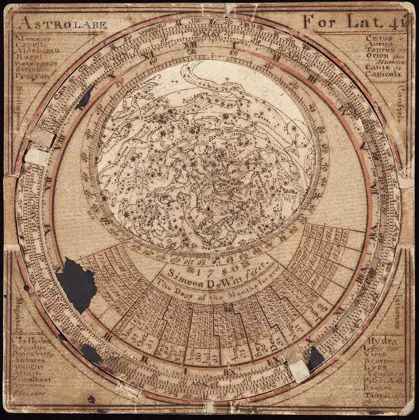 Worth knowing
Celestial Planisphere Called Astrolabe for Latitude 41
The title uses both the word planisphere and the word astrolabe, and the object name says planisphere. The description says the object is a hand-drawn paper star map, and it contains a stray double comma.
The record says: title: "Celestial Planisphere Called Astrolabe for Latitude 41" | This small,,square paper instrument is the oldest surviving Anglo-American star map.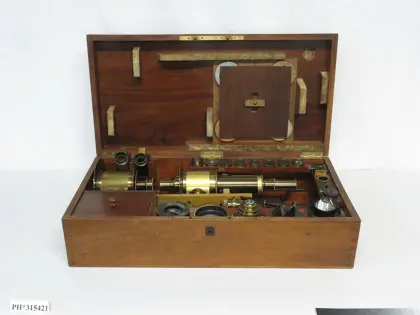 Worth knowing
Projection Polariscope
The title says polariscope while the object name says polarimeter. The date field is "late nineteenth century", and the description places the introduction of the form more narrowly, in the mid-1870s.
The record says: title: "Projection Polariscope" | object name: "polarimeter" | date made: "late nineteenth century" | the scientific instrument maker who introduced the form in the mid-1870s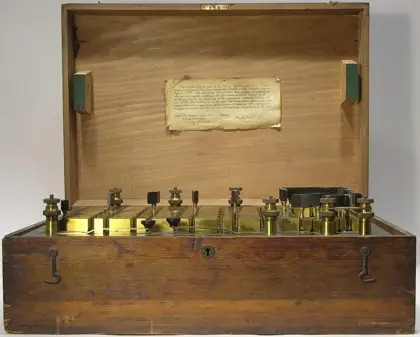 Missing information
Wheastone Bridge
The title spells the name "Wheastone" (the physicist was Wheatstone). The record also has no date, no place, and no description; only a maker and the location note are present.
The record says: title: "Wheastone Bridge" | maker: "Queen and Company" | Location: "Currently not on view"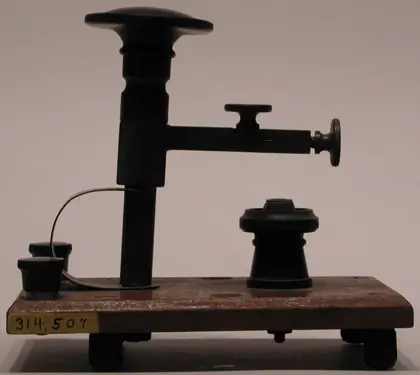 Missing information
Fessenden electrolytic radio signal detector
The record gives a date, a maker, and an associated person (the same name appears under both labels) but no description, so how the detector worked and what it looked like are not in the text.
The record says: date made: "1903" | associated person: "Fessenden, Reginald Aubrey" | maker: "Fessenden, Reginald Aubrey" | Location: "Currently not on view"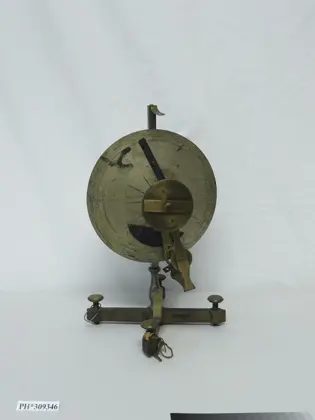 Date
Terrasphere
The date field is empty, but the description cites two patents a year apart (1866 and 1867). The model is stated to be for the first, so the date can be read from the text, but not from the date field.
The record says: Patent model for Eleazer Root, “Terrasphere,” U.S. Patent 60,642 (Dec. 18, 1866). | See also Eleazer Root, “Improvement in Terrasphere,” U.S. Patent 69,842 (Oct. 15, 1867).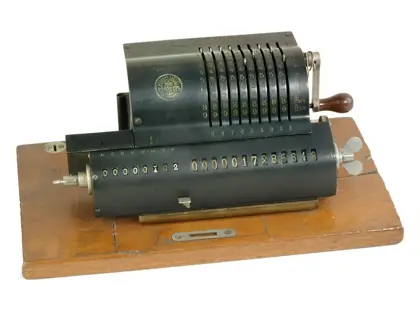 Place
Odhner Arithmometer
The place hierarchy repeats the city in two spellings, and the maker's nationality (Swedish) appears only in the description. A reader sorting by place sees Russia; a reader of the description sees a Swede working in Russia.
The record says: place made: "Russia: Saint Petersburg, St. Petersburg" | the Swede W. T. Odhner, who worked in St. Petersburg, Russia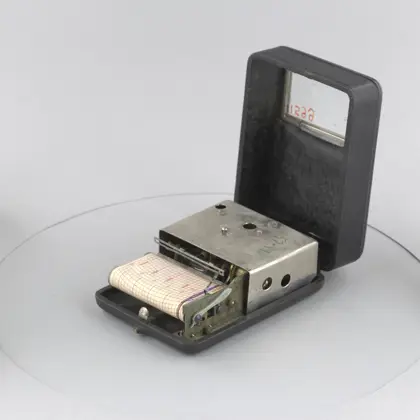 Date
Barograph
The date field is empty, but the physical description includes "circa 1918". The date is in the record, in a different field.
The record says: Range 10,000ft.; circa 1918; pocket model; duration use: 3 hrs.