Science
My PhD at Harvard was in perception and cognition. Most of my research asks what people can and cannot see, and why. Two of the findings are below in a form you can try.
Try it: crowding
You can see more than you can pick out
In 1996, Sheng He, Patrick Cavanagh, and I showed in Nature that the grain of attention is much coarser than the grain of vision. You can see things that you cannot pick out one at a time.
Keep your eyes on the cross. Every few seconds the patches fade and come back at new angles. You can tell the middle patch is there, but with its neighbors close you can't tell which way it tilts. Spread them out and it gets easier. Click the gray to move the cross. Drag to slide the patches around.
Each time the patches come back, the middle one has a coin-toss chance of tilting the other way. Press the space bar or "I saw it change" when it does. The change happens while the patches are gone, so there is no flicker to catch: you have to know which way it tilted before and after.
The effect is much stronger in your upper visual field. The two crosses sit the same distance above and below the patches: look at the lower one, then the upper one, and compare how easy the tilt is to see.
Near and far
Put the cross near the patches and the neighbors stop getting in the way: crowding grows with distance from where you look. The display is the classic crowding demo, redrawn. It is not a figure from the paper.
Test yourself
Keep your eyes on the cross and say which way the middle patch tilts. It stays up until you answer. Use the buttons or the left and right arrow keys.
Measure it
Each trial starts with the middle patch upright. A moment later it turns a little to the left or right, and you say which way. The neighbors change at a set time before or after it, or stay still. A Psi staircase (Kontsevich and Tyler, 1999) picks each turn and estimates two numbers for every setting: the turn that looks straight to you (the PSE), and how much turn you need to tell left from right (the JND, the sigma of a cumulative Gaussian).
These are informal measures on your own screen, not lab results, and they only work if you keep your eyes on the cross.
My thesis paper, "The spatial resolution of visual attention" (Cognitive Psychology, 2001, with Patrick Cavanagh), maps how finely attention can select across the field of view.
Three ways into Figure 14. The spacing follows what the paper measured: the closest spacing attention can still pick apart grows with distance from where you look, it is about 50% wider along lines out from the center than around a circle, and it is wider above the cross than below it. These run on your own screen, so sit close and keep your eyes on the cross.
Patches everywhere
Every patch tilts left or right. Keep your eyes on the cross and move your attention from patch to patch: can you get the tilt of each one? Turn the density up and you can still see that the patches are there, but you can no longer pick them out one at a time. Flip it and the finer spacing moves to the upper field, where attention is coarser.
Walk your attention
This is the task from the paper's second experiment. One disk turns red: put your attention on it. Then arrows appear at the cross, and you step your attention one disk left or right for each arrow, without moving your eyes. At the end a disk turns red again. Is it the one you ended on? Press Y or N. Add disks until you lose your place, and compare the upper field with the lower one.
Count the ring
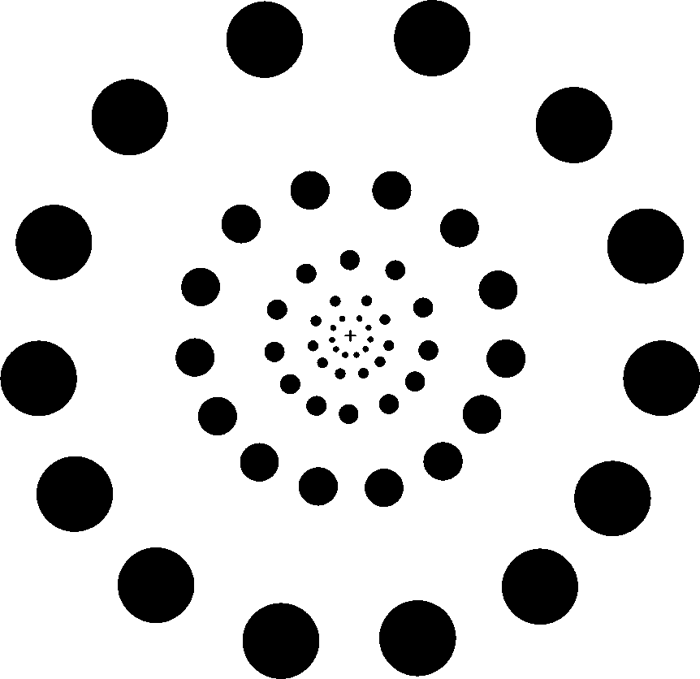
To count past four you have to pick out each dot in turn and remember which ones you have done. Keep your eyes on the cross and count the dots in the ring. With a few dots it is easy. With many, you can see every dot clearly and still lose count.
- Nature 383, 334 to 3371996. "Attentional resolution and the locus of visual awareness." He, Cavanagh, and Intriligator. Read it
- Cognitive Psychology2001. "The spatial resolution of visual attention." Intriligator and Cavanagh.
Try it: wakes and spokes
Spokes and wakes that are not there
With Alex Holcombe, Stephen Macknik, Adriane Seiffert, and Peter Tse, I described two new illusions in Perception (1999). Discs circling the point you look at seem to pull dark spokes toward it and to leave wakes behind them. In Perception and Psychophysics (2000), Holcombe, Tse, and I showed that the spokes fade as the discs approach the brightness of the background.
Keep your eyes on the cross. Most people see a faint dark band joining each disc to the cross (a spoke) and a dark trail behind its outer edge (a wake). The gray is one flat value: neither is on the screen. Slide Background past the middle and the discs turn black. Then the spokes and wakes look lighter than the gray.
Change the display
The first four displays follow the papers. The drawn spokes below them are my variations on the theme. Every version is my redrawing, not an original stimulus, and the motion stops by itself after thirty seconds. In the papers, the discs were two to three degrees across and about three and a half degrees from the point people looked at, circling at five to nine degrees of visual angle per second.
Other findings
A patient with cortical color blindness could still see motion carried only by color. Nature Neuroscience 1(3), 242 to 247.
Two papers on a patient with a posterior callosal lesion, whose two hemispheres read in different ways: "Two different readers in the same brain" and "Able to name, unable to compare," both in NeuroReport. I did this work as a Visiting Scholar at INSERM in Lyon, 1994 to 1995.
Attended events seem to last longer. Perception and Psychophysics.
A real-time method for making random-dot motion displays with a set coherence. Spatial Vision, sole author.
With Stephen Kosslyn, an argument against single-method science: "Is cognitive neuropsychology plausible? The perils of sitting on a one-legged stool." Journal of Cognitive Neuroscience. It was translated into Italian in 1994.
Neurology research at Beth Israel with Jason Barton and others, on eye movements, face recognition, schizophrenia, and blindsight.
About a dozen papers in space physics with D. S. Intriligator at the Carmel Research Center, on the solar wind and on Voyager data at the edge of the solar system.
Consumer neuroscience at Bangor: brand logos bias emotion-based learning (Applied Cognitive Psychology, 2012); a go/no-go task reveals brand influence (PLoS ONE, 2015); and "Quick as a BLINK," a fast version of the Iowa Gambling Task (2011).
Players of online role-playing games who report hostility also report cognitive and social benefits, depending on the role they play. Cyberpsychology, Behavior, and Social Networking.
Chimpshop: science turned into a game
At Bangor I founded and directed a spin-out, Attention Retraining Technologies, starting in 2013. Its phone game, Chimpshop, retrains attention away from images of alcohol. Players run down supermarket aisles while chimps throw products at them.
The research idea is W. Miles Cox's. My part was turning it into an app. The UK Technology Strategy Board and the NHS funded it, and we wrote it up as "Chimpshop and alcohol reduction" in Perspectives in Public Health in 2015. Bangor's news story
My papers are listed on Writing and talks.