Theory and methods
I work on problems that belong to no single field. Transversal Design is my name for how I do it, and gliding is how I do it with AI.
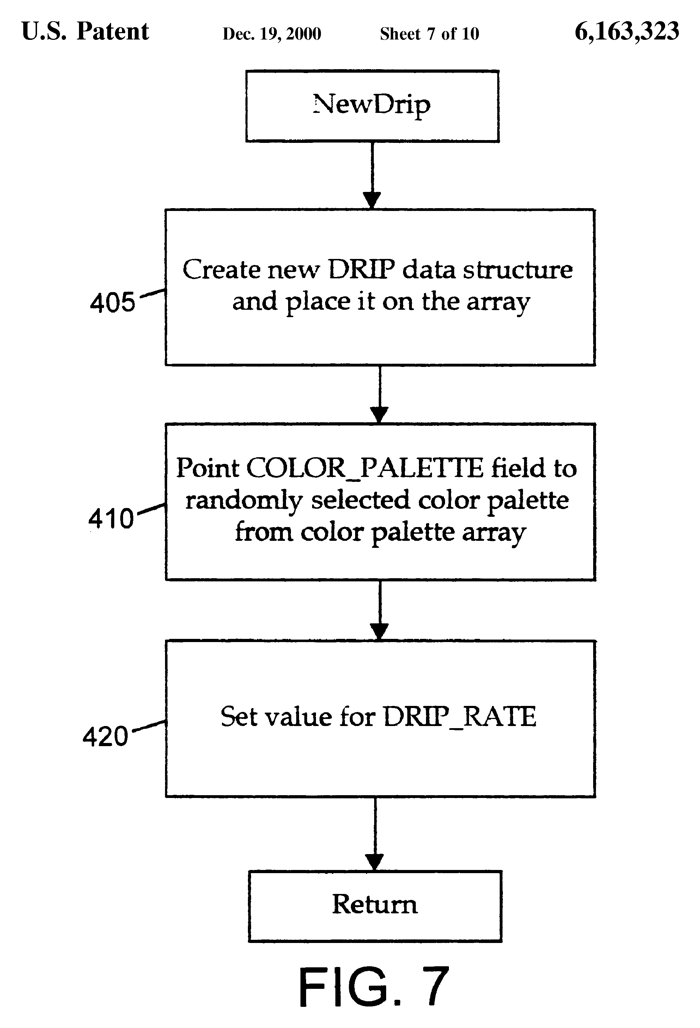
In 1998, a year after finishing my PhD at Harvard, where I studied how attention shapes what we see, I was also making generative light pieces for music with software I had written. Putting the two together produced a method for animations that seem to keep time with whatever music is playing. It became US patent 6,163,323 in 2000.
It needed both: research on how people see motion and pattern, and a working body of images and music to try it on. The invention sat in the ground between them, which is where I have found most of the ideas worth building since.
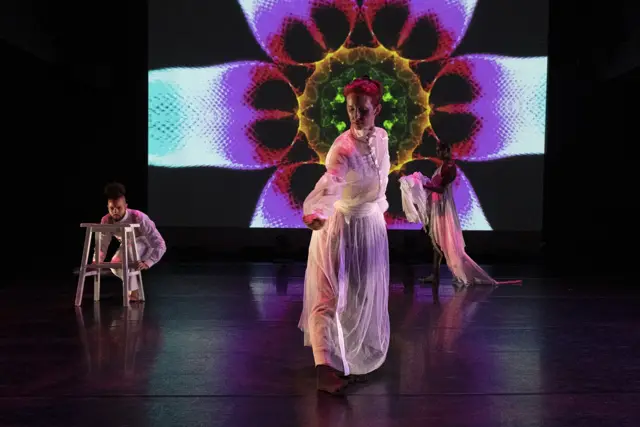
The word "transversal" comes from theory I have written with the playwright and theorist Bryan Reynolds since 1998, under our shared pen name, zooz. Our talk at the Harvard Manifestos Conference in May 1998 was called "Transversal Power: From molecules, to Jesus, to the Grateful Dead, and beyond."
"Transversal Poetics: I.E. Mode" followed in GESTOS and in the book Performing Transversally, both in 2003, and in a Romanian translation in 2006. "Continuous R(E)volutions" appeared in postmedieval in April 2010. Bryan also founded the Transversal Theater Company, and I made the visuals for two of its productions, Curie Curie and The Passage.
Real problems live across many dimensions at once: the people involved, the institution around them, the materials, the money, the rules, the history, and how everyone feels about it. Most methods pick one of those and work inside it. Transversal Design maps the dimensions a problem really has, moves across them on purpose, and looks hard at what shows up between them. The output is something you can build: a mechanism, a program, or a system.
It is the design method I built on transversal theory, through years of teaching, consulting, and building.
In 2023 I wrote in The Conversation that the best way to work with a language model is to glide, not search: steer a long conversation across a problem, instead of firing single questions at it. Models are very good at range. What a model says should be treated, as I put it then, as "imaginative conjectures that require further verification, analysis and filtering by you, the human pilot." Read the article
Named methods
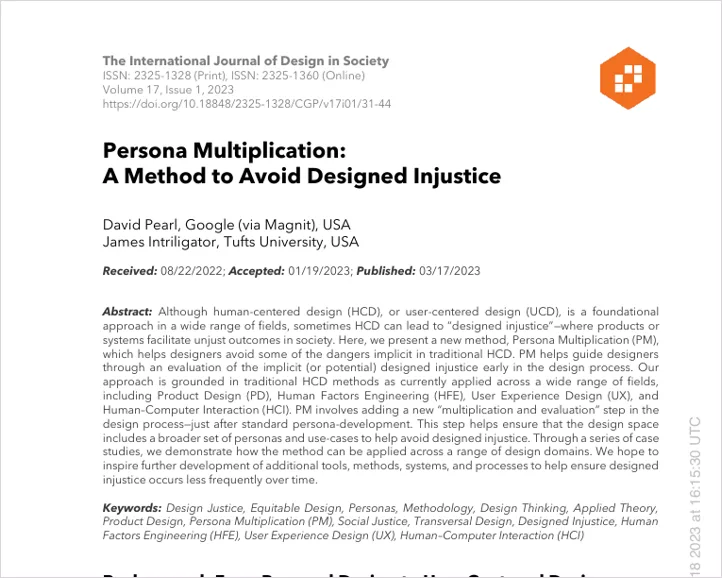
Persona Multiplication
Developed with David Pearl. Human-centered design usually works from a handful of typical users, and the people it leaves out can end up harmed by the result, which we called designed injustice. Persona Multiplication adds a step just after the usual personas are written: multiply them across a much wider range of people and uses, and evaluate the design against each.
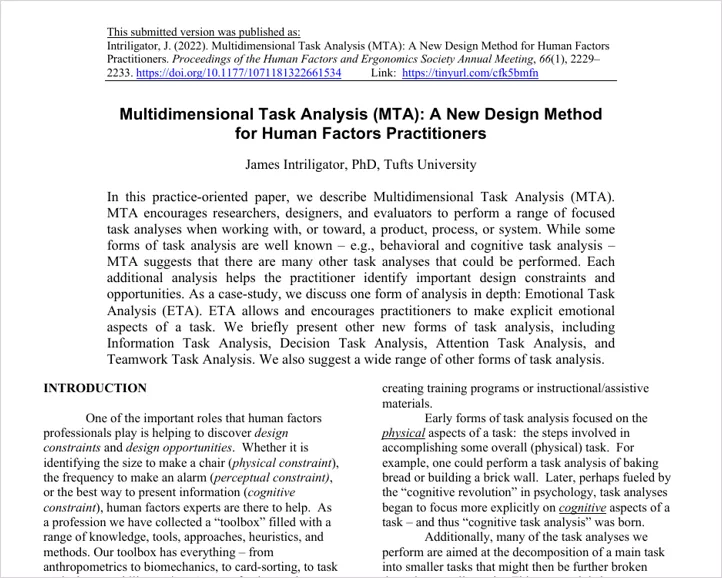
Multidimensional Task Analysis
Human factors has long analyzed tasks by what people do physically and mentally. Multidimensional Task Analysis adds analyses of emotion, information, decisions, attention, and teamwork, because each one finds design constraints and opportunities the others miss. The 2022 paper works through Emotional Task Analysis in depth.
Proceedings of the Human Factors and Ergonomics Society 66(1), 2022
Polymorphic Combinatorial Frameworks
With David Pearl and Matthew Murphy, a framework for designing adaptive AI agents on a mathematical footing. Posted on arXiv on Aug 3rd, 2025.
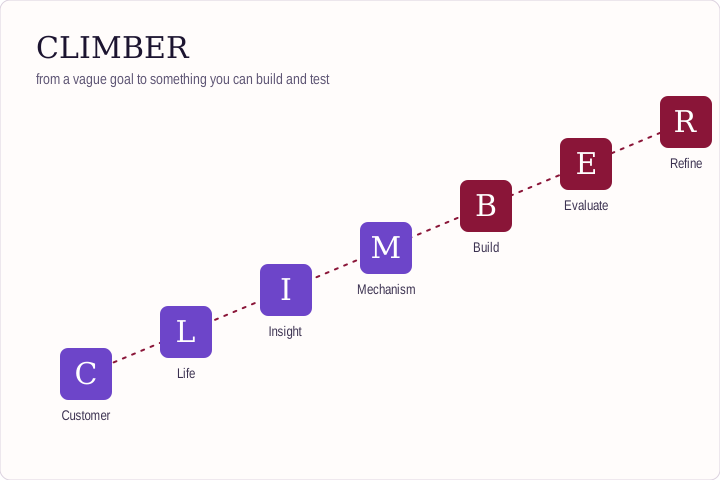
CLIMBER
I have developed CLIMBER over the past ten years, and taught it to (and seen it used by) hundreds of students. It is a design-thinking model in seven steps: Customer, Life, Insight, Mechanism, Build, Evaluate, and Refine. It separates the person a design is for from the life around them, so the context gets a step of its own. It adds a step most design-thinking models leave out: Mechanism, where you work out how the idea will actually work before you build it. Each step comes with its own short toolkit. The last step is Refine: what you learn sends you back to the step it changes, which is just as often Customer or Life as it is Build. Not yet published.
In a long session with a language model, how much of the insight comes from the person and how much from the model? I am studying hundreds of my own sessions to find out.
Why do language models seem able to recover more structure than anyone put into them, and what should that change about how we use them?
What does human factors engineering look like when the thing being designed is a whole working relationship between people and AI systems?
How does design change when technology can make almost anything we can describe?
My articles, papers, and talks are listed on Writing and talks. For how my company applies these methods, see How we think on the Glider Innovations site.