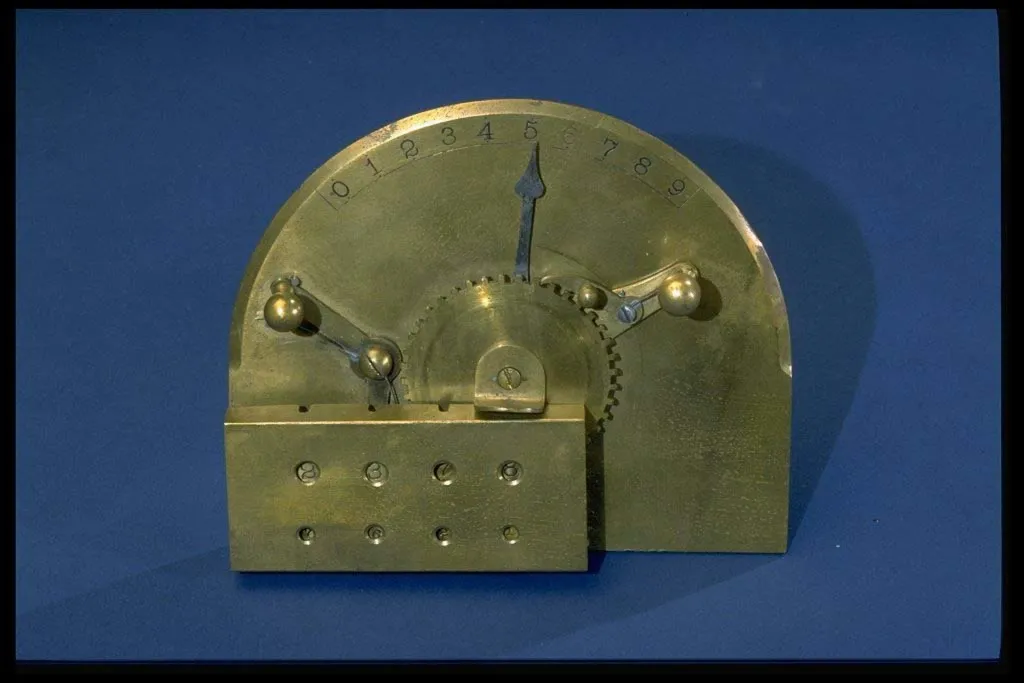
Baldwin Arithmometer
Setting digits on its wheels or keys added and multiplied numbers mechanically, so a clerk did less arithmetic by hand.
- Date
- 1874
- Maker
- Frank S. Baldwin
- Place
- United States: Pennsylvania, Philadelphia
- Materials
- brass (overall material); steel (overall material)
- Dimensions
- overall: 2 cm x 13 cm x 11.3 cm; 25/32 in x 5 1/8 in x 4 7/16 in
- Museum
- National Museum of American History
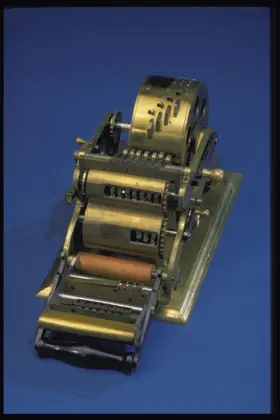
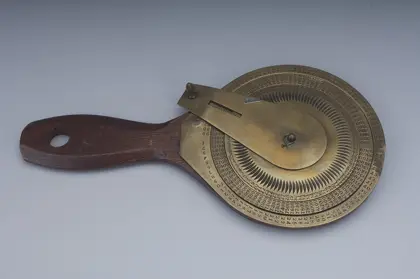
This is the United States Patent Office model for a machine for adding a column of digits patented by Frank S. Baldwin, who is listed on the patent as a resident of Philadelphia. It is the second of several patents Baldwin filed relating to adding and calculating machines.
The machine's back is roughly a half-disc, with the digits from 0 to 9 engraved across the top. A steel arrow rotates to point to any one of these digits. Rotating a brass knob returns the arrow to place. The knob is linked by gears to a small movable carriage at the base of the device. Returning the knob to its original position rotates two small register wheels. One of the wheels records the sum of the number entered and the number already set in the wheels. The other records the complement of this number. There are four sets of register wheels, linked to one another so that the machine carries, hence the machine may add numbers up to 9999.
A committee of J. W Nystrom, John Groesbeck, and Pliney E. Chase commented favorably on this machine before the Franklin Institute in Philadelphia. It received the Scott Medal of the Franklin Institute in 1874, and was produced in small numbers.
References:
U.S. Patent 153,522, July 28, 1874.
Thomas A. Russo Sr., and Conrad Schure, “The Calculating Engines of Frank S. Baldwin,” Rittenhouse, 11 #3 (May 1997), pp. 93-96.
The museum's own record (Smithsonian, National Museum of American History)
Also by Frank S. Baldwin see all
Also made in Philadelphia see all
 William W. Wythes Cyclo-Ellipto-Pantograph Patent Model
 Patent Model for Circular Slide Rule Invented by John W. Nystrom
 Pocket compass from the Lewis and Clark Expedition, 1804-1806
 Surveyor's Vernier Compass
 polariscope
Also answering “How much?” see all
 Patent Model for Estimator Slide Rule Invented by Fredric Maurice Stapff
 Barbour Calculating Machine
 Baldwin Calculating Engine
 Barbour Calculating Machine Model
 Rotating Mathematical Table, Sinclair's Freight Computer
 Log and Rotor, Patent Model
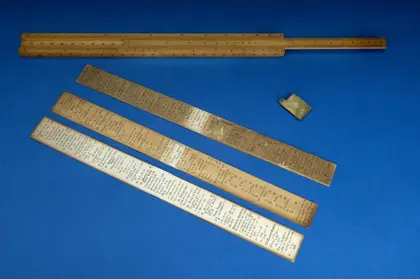 Patent Model for Simplex Slide Rule Clasp Invented by Rudolph C. Smith
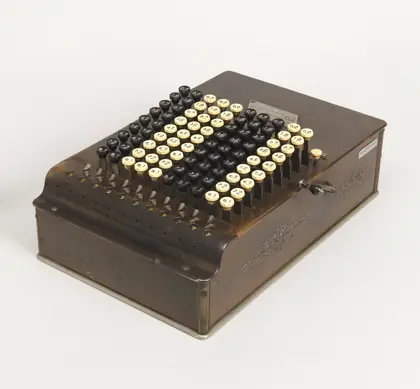 Comptometer
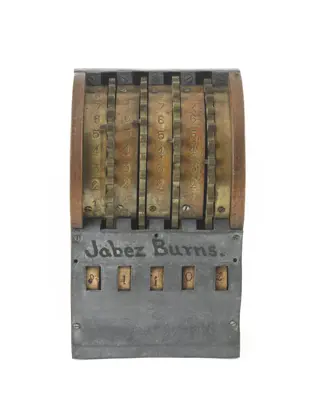 Burns Addometer
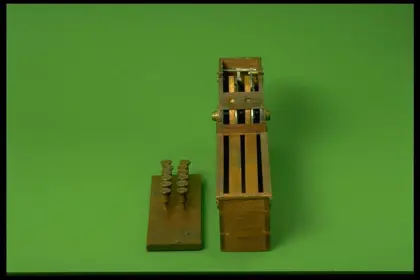 Hill Arithmometer
 Hatfield Machine for Adding Numbers
 Keuffel & Esser 1741 Thacher Cylindrical Slide Rule