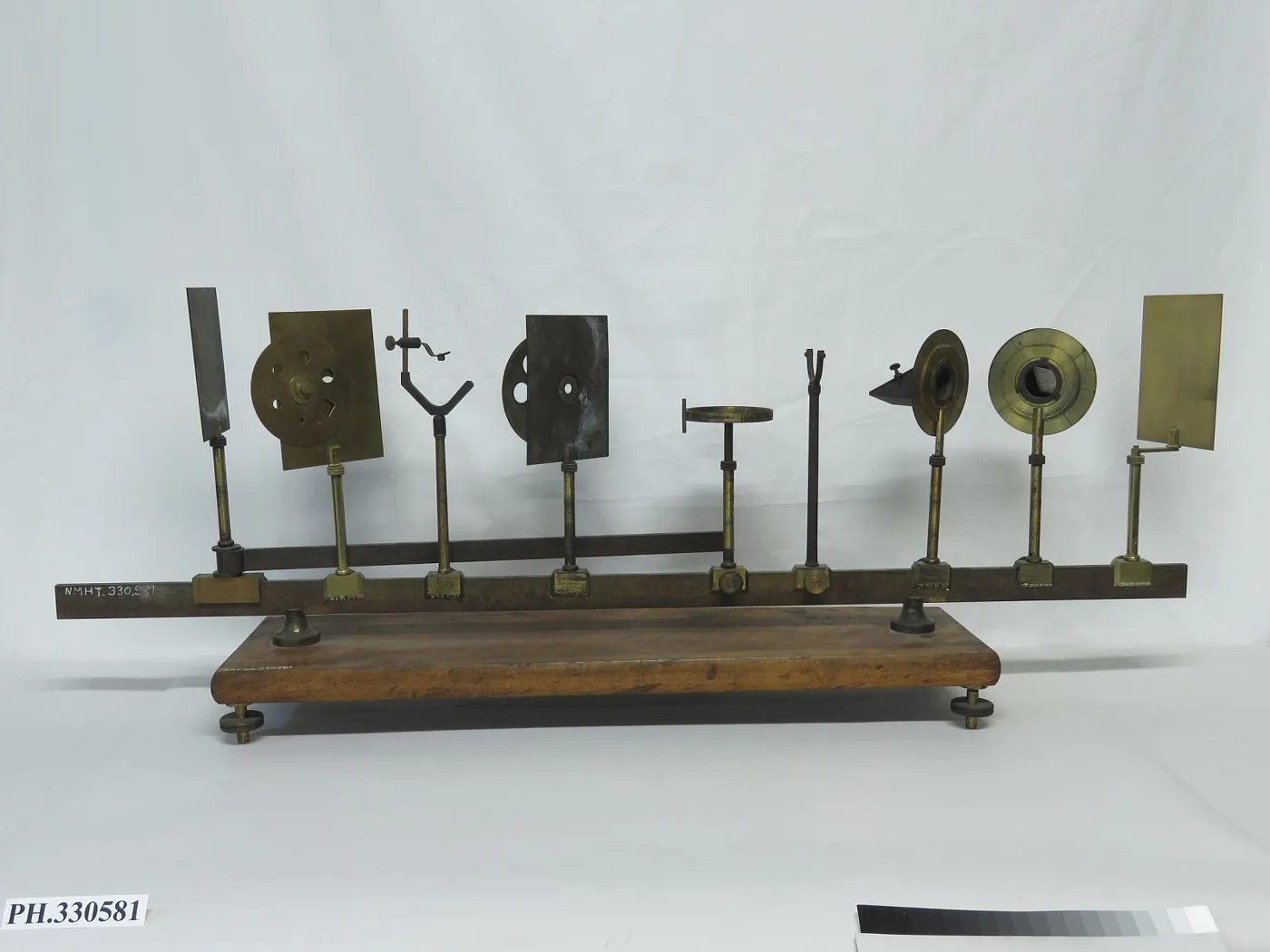
Melloni Bench
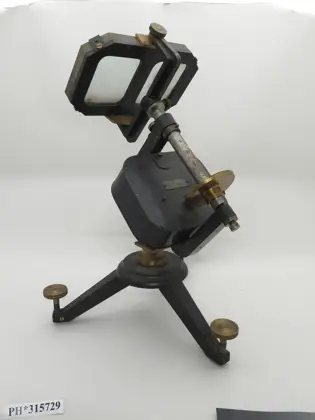
A heat-sensitive thermopile measured invisible radiant heat from a source, which could be passed through different materials on the bench.
- Date
- early 1840s
- Maker
- Heinrich Daniel Ruhmkorff
- Place
- France: Île-de-France, Département de Ville-de-Paris
- Dimensions
- overall: 15 1/16 in x 40 in x 7 in; 38.25875 cm x 101.6 cm x 17.78 cm
- Museum
- National Museum of American History
- Credit line
- Princeton University
Joseph Henry, the first notable American physicist after Franklin, was in Europe in 1837, meeting scientists and purchasing apparatus for research and classroom demonstrations at the College of New Jersey (now Princeton University). While in Paris, Henry spent time with Macedonio Melloni, the Italian physicist who had recently connected the properties of radiant heat with those of visible light. In 1841, Henry commissioned a travelling friend to procure a Melloni apparatus from Heinrich Daniel Ruhmkorff, an up-and-coming instrument maker in Paris. This example, used at Princeton, seems to be part of that apparatus. The inscription reads “Ruhmkorff Rue des Orfevres 6.”
Ref: Ref: Emanuela Colombi, Matteo Leone, and Nadia Robotti, “The emergence of Melloni’s optical bench,” European Journal of Physics 38 (2017).
The museum's own record (Smithsonian, National Museum of American History)
 Solar Microscope
 Polariscope
 Polariscope
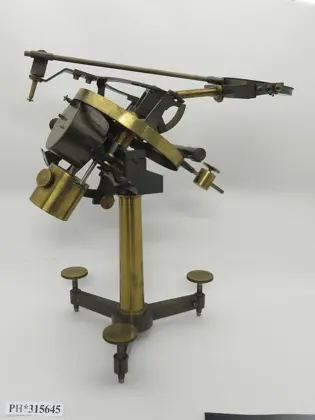 Heliostat
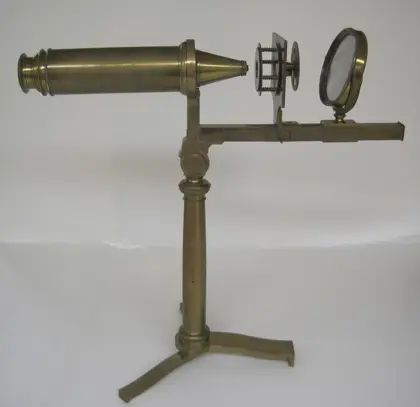 Microscope, Lerebours
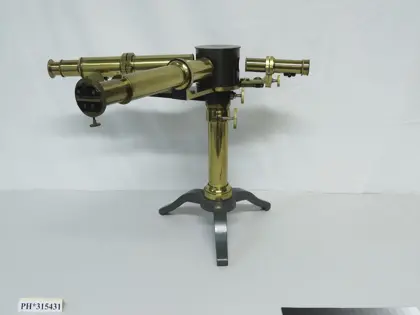 Spectroscope
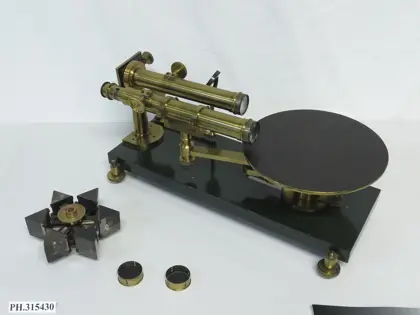 Spectroscope
 Spectrometer
 Jamin Apparatus
 Projection Polariscope
 Microscope
 Heliostat