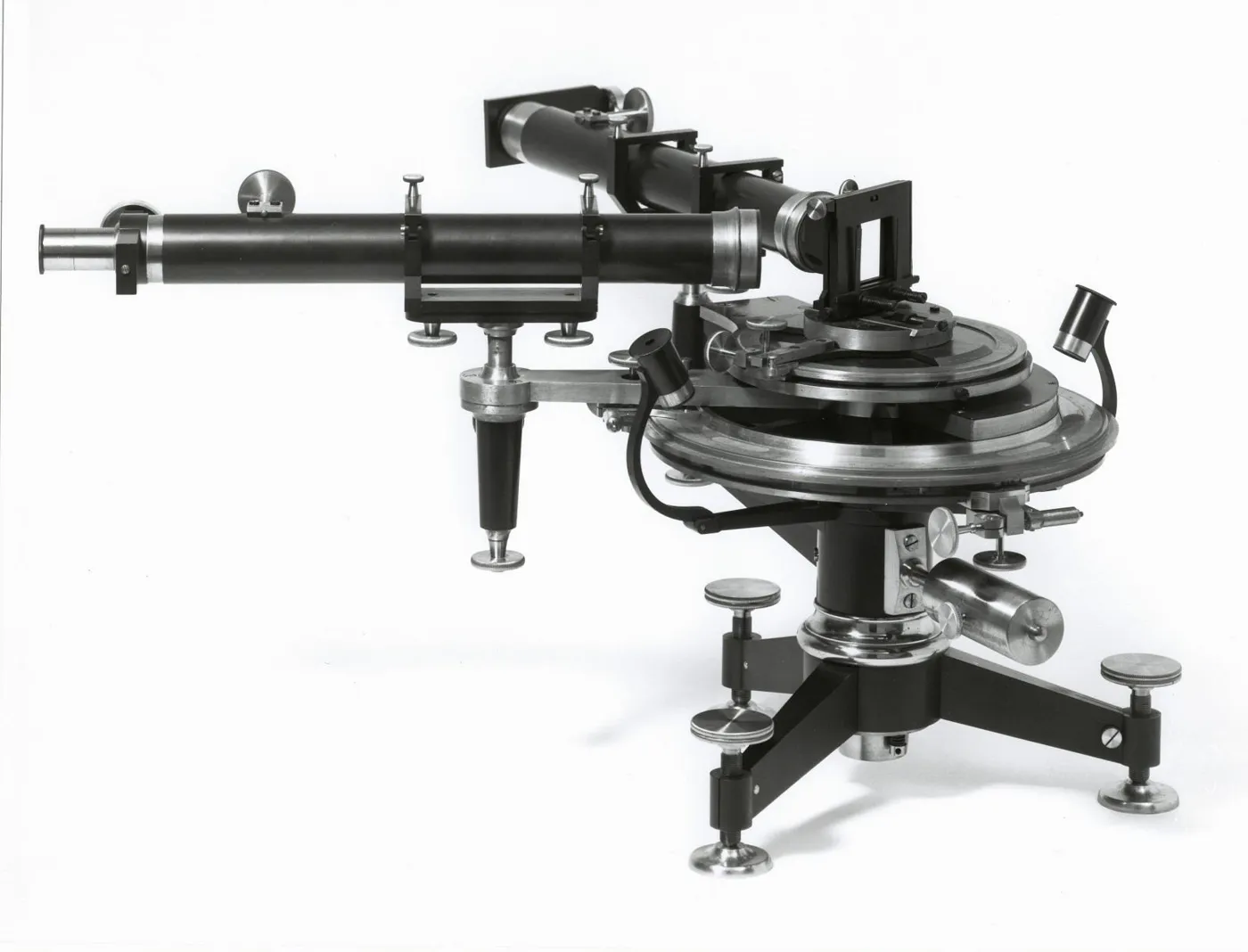
Spectrometer
A prism or grating split light into colors, and a circle with a telescope measured the angle of each color precisely.
- Date
- 1873-1881
- Maker
- William Grunow
- Place
- United States: New York, New York City
- Dimensions
- overall: 12 1/2 in x 34 in; 31.75 cm x 86.36 cm; overall: 12 3/4 in x 24 in x 13 1/4 in; 32.385 cm x 60.96 cm x 33.655 cm
- Museum
- National Museum of American History
- Credit line
- U.S. Military Academy
This instrument, which could be used with either a prism or a diffraction grating, has a graduated horizontal circle read by microscopes and verniers. The “Wm. Grunow / New York” inscription refers to William Grunow (1830-1917), a German craftsman who, with his brother Julius, came to the United States in 1849 and went to work making microscopes. In 1873, now settled in New York, Grunow announced his willingness “to execute all orders for philosophical instruments.” In 1881 he moved to West Point, and spent the next 36 years as custodian of the astronomical observatory of the U.S. Military Academy.
Ref: D.J. Warner, “Julius & William Grunow,” Rittenhouse 3 (1989): 41-48.
The museum's own record (Smithsonian, National Museum of American History)
Also by William Grunow see all
Also made in New York City see all
 Spectroscope
 Burns Addometer
 Sextant
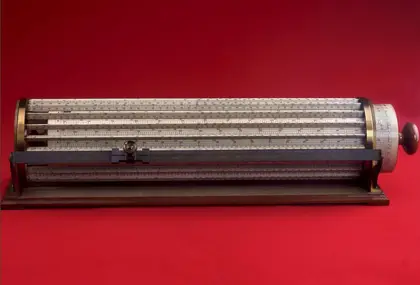 Keuffel & Esser 1741 Thacher Cylindrical Slide Rule
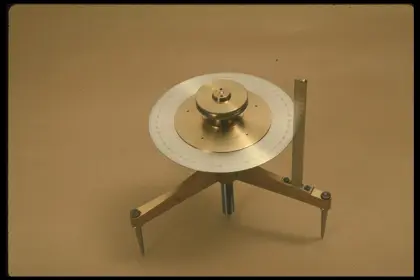 Grunow Spherometer
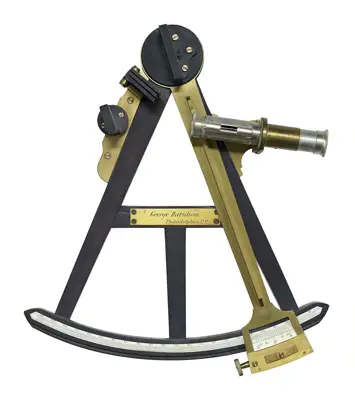 Octant
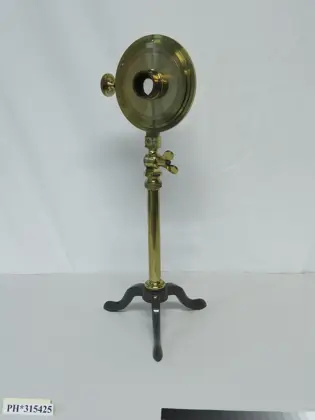 Jamin Apparatus
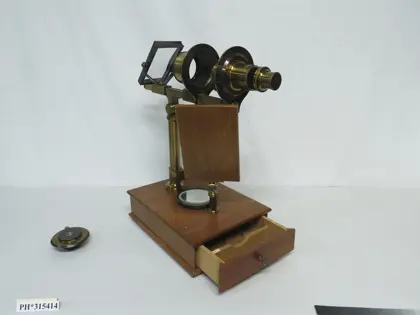 Projection Polariscope
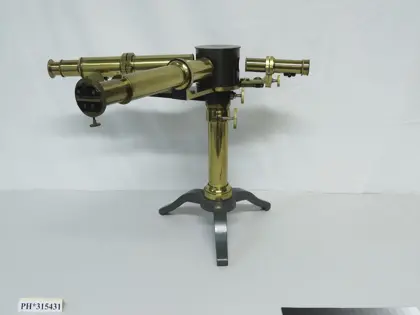 Spectroscope
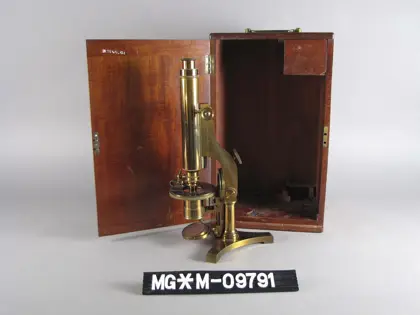 Microscope
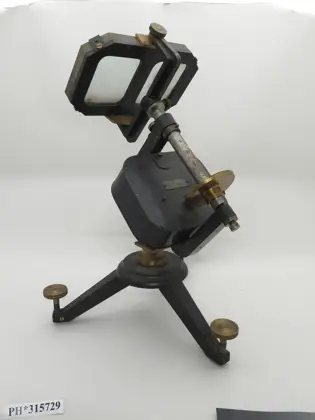 Heliostat
 Solar Microscope
 Melloni Bench
 Polariscope
 Ski-Optometer (Woolf Phoropter)
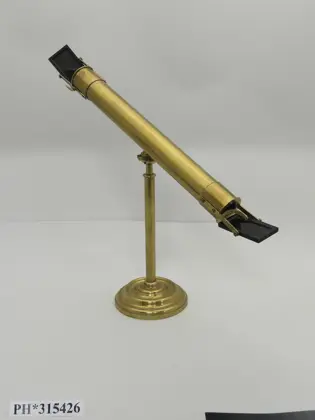 Polariscope
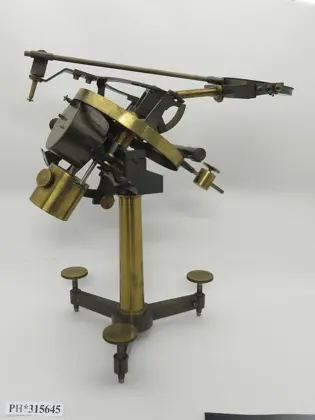 Heliostat