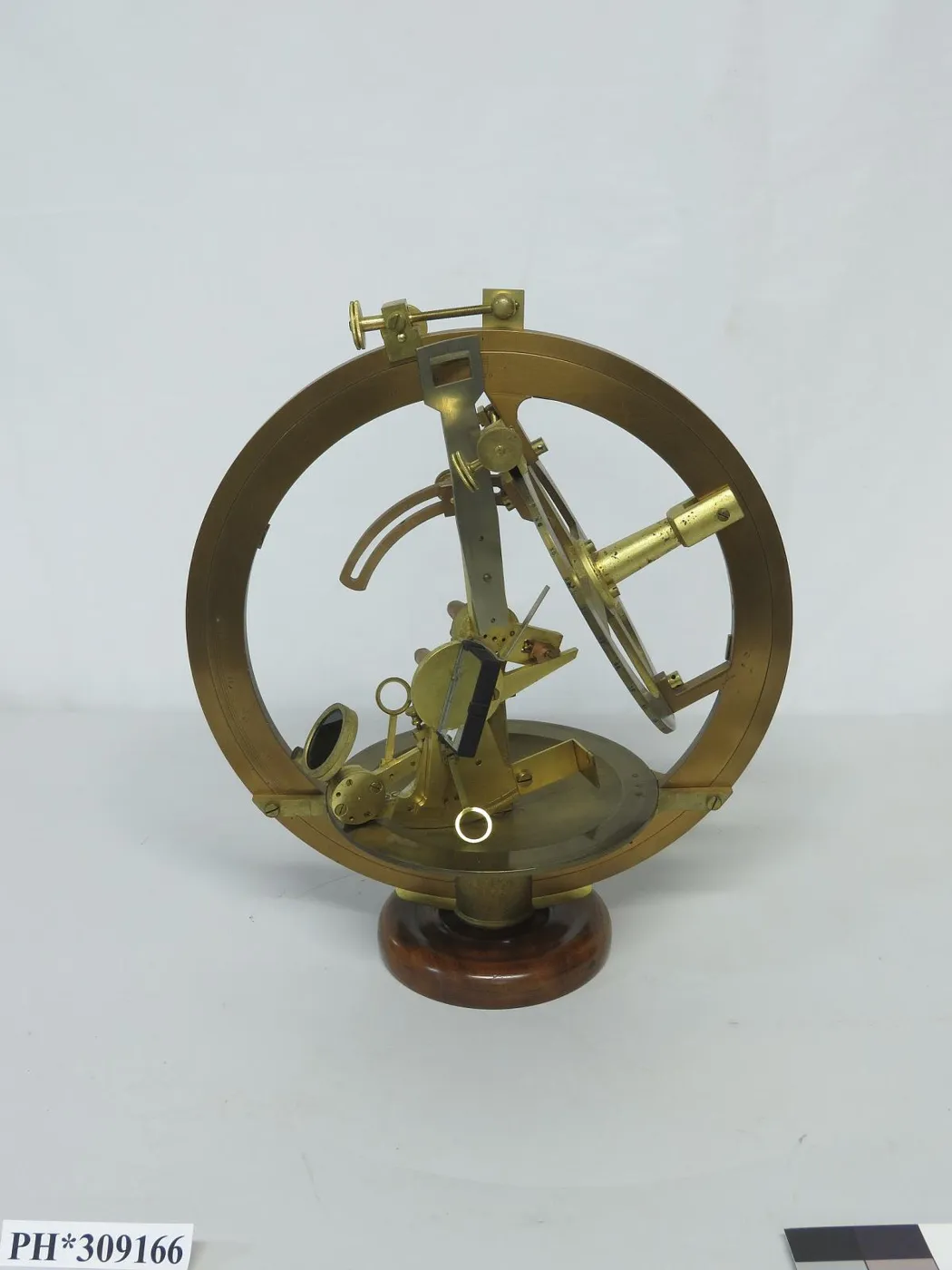
Equatorial Sextant
A rotating frame of circles and sights let a navigator measure the sun's height and direction to find a ship's position.
- Date
- 1856
- Maker
- William A. Burt
- Dimensions
- overall: 11 7/8 in x 10 1/4 in x 5 5/8 in; 30.1625 cm x 26.035 cm x 14.2875 cm; overall: 12 in x 11 in x 5 in; 30.48 cm x 27.94 cm x 12.7 cm
- Museum
- National Museum of American History
Patent model for William Austin Burt, new equatorial sextant, U.S. Patent 16,002 (1856). This instrument could apparently be used to take azimuths, altitude, and time with one observation, and thus enable one to easily obtain the position and bearing of a ship at sea. It was ingenious, but never found much of a market. Burt is better remembered for the solar compass that he introduced in the 1830s.
Ref: John S. Burt, They Left Their Mark. A Biography of William Austin Burt (Rancho Cordova, Ca., 1985), pp. 128-130.
The museum's own record (Smithsonian, National Museum of American History)
Also answering “Where am I?” see all
 Sextant
 Liquid Compass
 Solar Compass
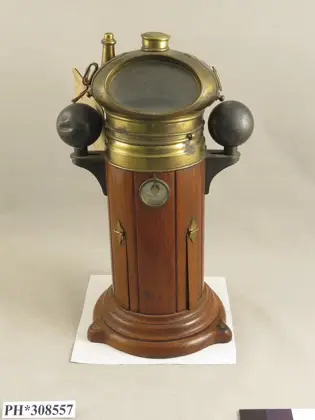 Dry Card Compass with Binnacle
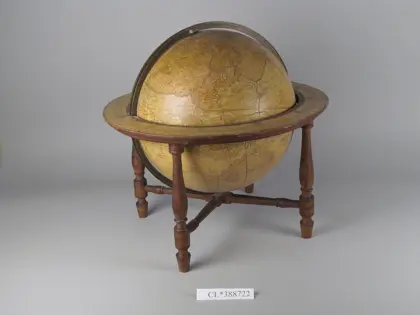 James Wilson's Terrestrial Globe, 1811
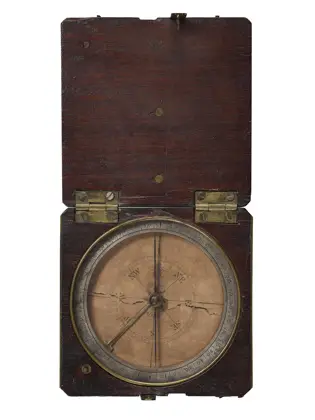 Pocket compass from the Lewis and Clark Expedition, 1804-1806
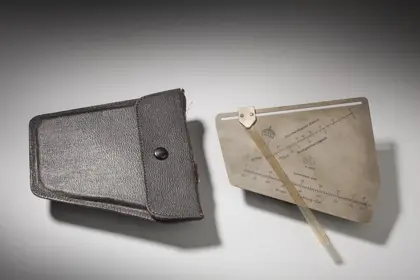 Plotter, Drift
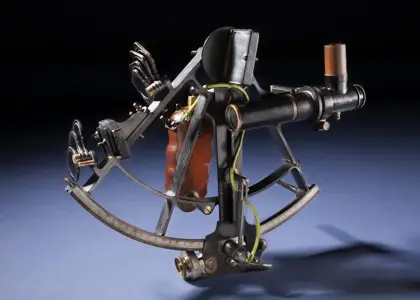 Sextant, Brandis, with Willson Bubble Telescope, Early
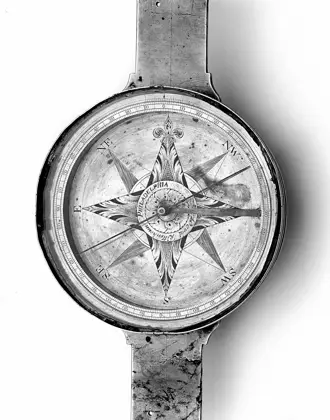 Surveyor's Vernier Compass
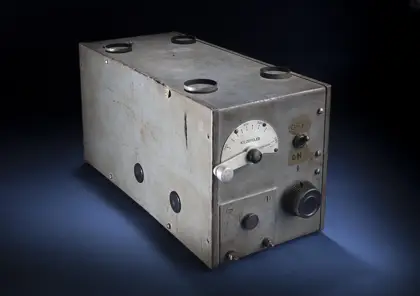 Receiver, Radio Range, ARC, Lab Prototype, Model B
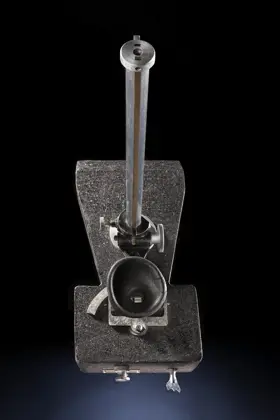 Sight, Drift & Ground Speed, Gatty
 Dead Reckoning, E-6B, Prototype