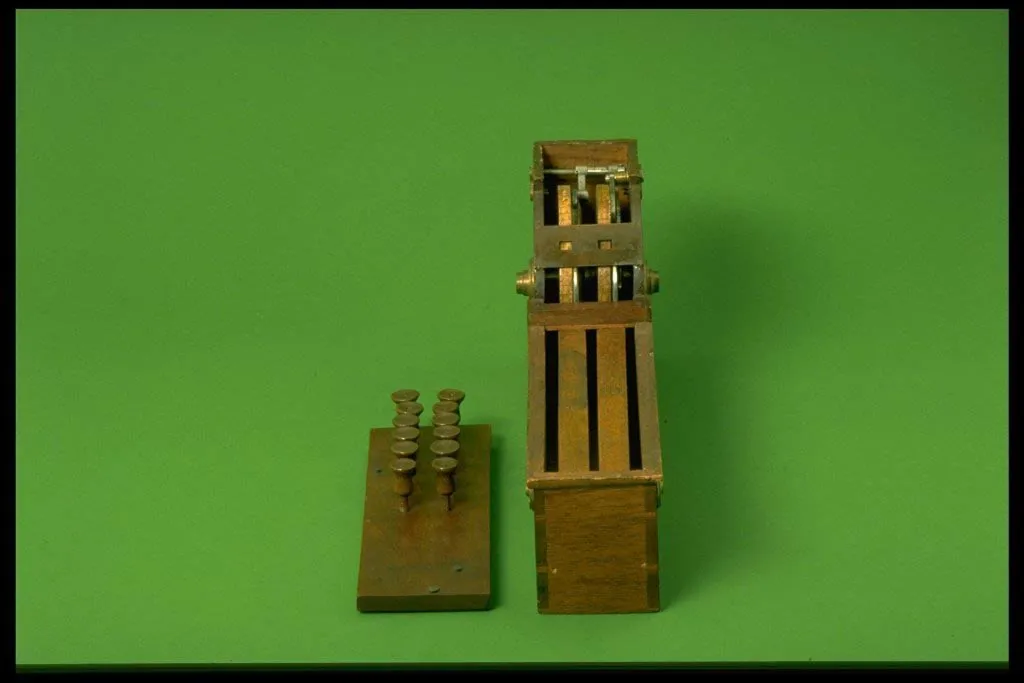
Hill Arithmometer
Setting digits on its wheels or keys added and multiplied numbers mechanically, so a clerk did less arithmetic by hand.
- Date
- 1857
- Maker
- Thomas Hill
- Place
- United States: Massachusetts, Waltham
- Materials
- wood (overall material); metal (overall material); paper (overall material)
- Dimensions
- overall: 12.5 cm x 7.5 cm x 30.8 cm; 4 29/32 in x 2 15/16 in x 12 1/8 in
- Museum
- National Museum of American History
This U.S. Patent Office model for an early key-driven adding machine has a wooden case with two columns of keys. Each column has six wooden keys. At the back are two wooden discs. Around the edge of each disc is a paper slip with the digits from 0 to 9 printed. These digits repeat seven times on each disc. To the right of each digit is, in smaller type, its nines complement, which is used in subtraction and division. Each wheel of the machine has attached to its side a ratchet that rotates according to the motion of a pawl. The base of the pawl is attached to the end of a lever that extends forward the length of the machine and is pivoted near the front. Above each lever, on the outside of the machine, is a column of keys, numbered from 1 at the top to 6 at the bottom.
To enter a number, the user depressed a key, which depressed the lever and moved the pawl, rotating the ratchet and wheel forward. Each wheel also had a toothed disc attached to it. After the wheel rotated forward past a "9" position, a tooth on the disc encountered a metal arm which drove a pawl on the adjacent wheel forward one position, causing a carry.
Thomas Hill, who took out a patent on this machine, was a Unitarian minister and, for a time, president of Harvard University. His patent did not result in a product.
References:
Thomas Hill, "Improved Arithmometer," U.S. Patent 18692, November 24, 1857.
Thomas Hill, "On a New Form of Arithmetical Complements," Proceedings of the American Association for the Advancement of Science, 1857, 11:82;
J. A. V. Turck, Origin of Modern Calculating Machines, Chicago: The Western Society of Engineers, 1921, pp. 22-29, 61-62.
P. A. Kidwell, “Thomas Hill: Minister, Intellectual and Inventor,” Rittenhouse, 12 (October 1998): pp. 111-119.
The museum's own record (Smithsonian, National Museum of American History)
Also answering “How much?” see all
 Burns Addometer
 Hatfield Machine for Adding Numbers
 Patent Model for Circular Slide Rule Invented by John W. Nystrom
 Grunow Spherometer
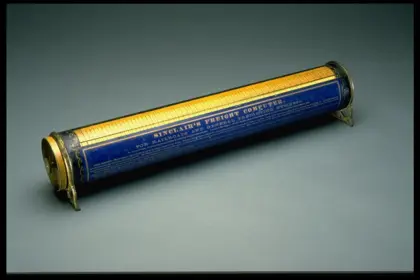 Rotating Mathematical Table, Sinclair's Freight Computer
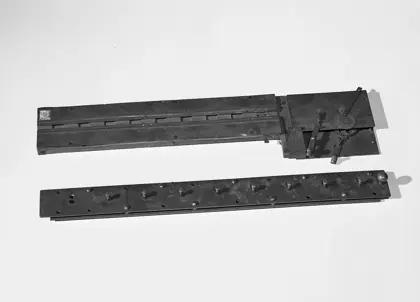 Barbour Calculating Machine Model
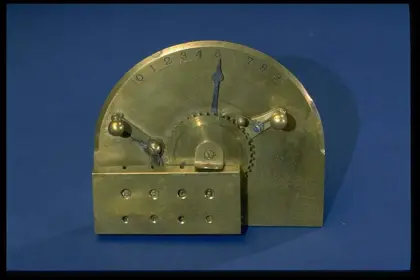 Baldwin Arithmometer
 Patent Model for Estimator Slide Rule Invented by Fredric Maurice Stapff
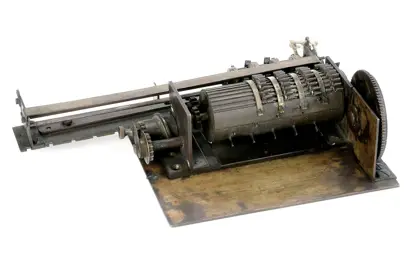 Barbour Calculating Machine
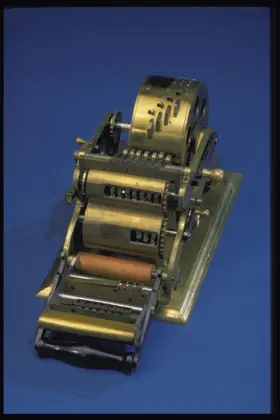 Baldwin Calculating Engine
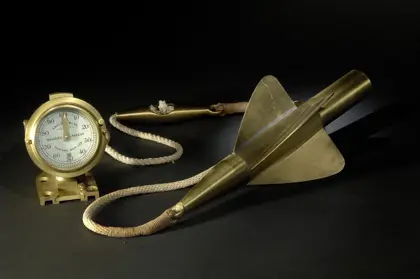 Log and Rotor, Patent Model
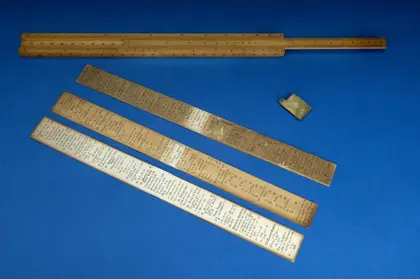 Patent Model for Simplex Slide Rule Clasp Invented by Rudolph C. Smith