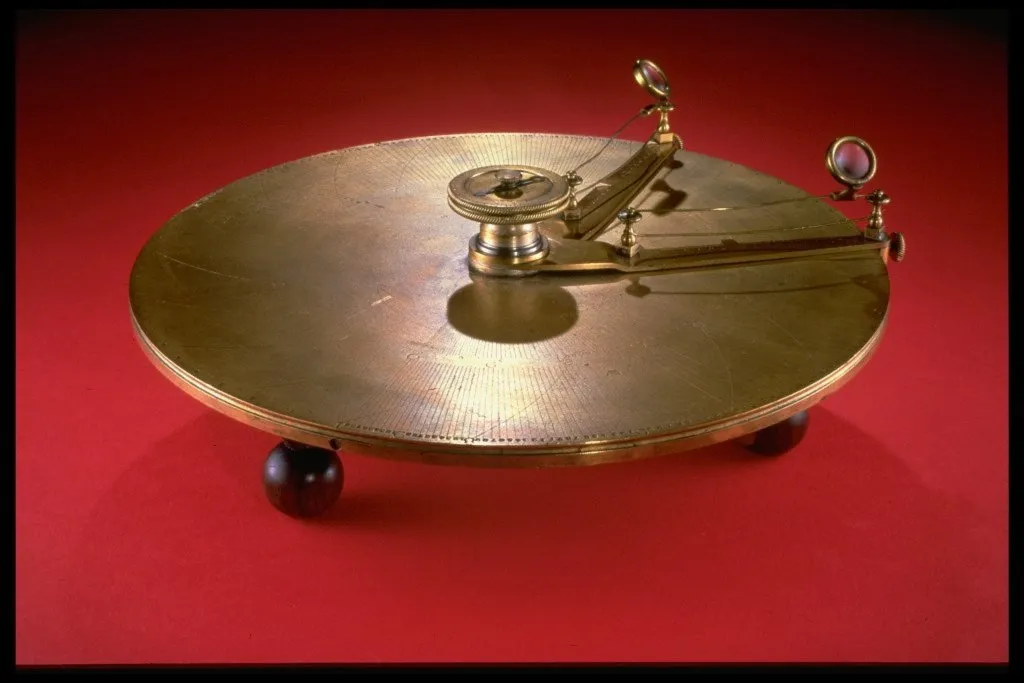
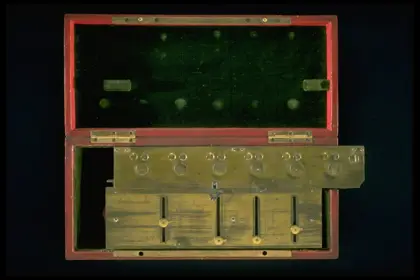
Patent Model for Circular Slide Rule Invented by John W. Nystrom
Turning the inner circle against the outer one multiplied and divided numbers, using scales of logarithms.
- Date
- before 1851
- Maker
- John William Nystrom
- Place
- United States: Pennsylvania, Philadelphia
- Materials
- wood (part material); glass (part material); brass (overall material); paper (sticker material)
- Dimensions
- overall: 17 cm x 23.8 cm x 24.8 cm; 6 11/16 in x 9 3/8 in x 9 3/4 in
- Museum
- National Museum of American History
The expansion of American engineering in the nineteenth century created a new market for aids to computation. The Swedish-born Philadelphia engineer, John William Nystrom (1824–1885), contributed to this movement by inventing a circular slide rule in 1848 and writing a pocket book of mathematical tables that was reprinted at least 21 times between 1854 and 1895.
This is the patent model for Nystrom's calculator. The surface is a brass disc that rests on three wooden feet. It has two graduated brass arms, pivoted about a central spindle, which may be clamped to any desired angular separation and rotated together. Glass magnifiers are attached to both arms. A small dial on the top of the central knob can be moved to record rotations of more than one full circle.
There are four unlabeled circles on the calculating rule, here called a, b, c, and d. They go from the outer rim inward. Circle b is divided into 20 equal parts. Subdivisions of these parts are represented by a series of parallel curves extending between the outer rim and circle b. These, in combination with scales marked on the rim of the arms, allow one to measure subdivisions of the distance between equal parts. The outermost circle (a) is a logarithmic scale ranging from 1 to 10 twice. A series of lines between the two outer circles give intermediate values, which are read from the rotating arms. The circle c, just inside b, is divided from 0 to 90 degrees so that the sine of an angle indicated is given on the outer circle a. The parts of the scale are unequal, with the tens value of degrees from 10 to 49 indicated by large digits. The innermost circle d is divided for finding cosines.
Nystrom promoted the device and solicited a manufacturer in the May 17, 1851, issue of Scientific American. By 1852, he offered the device at three price points, $10.00, $15.00, and $20.00. He was likely making the instrument himself. From 1864 to 1887, the Philadelphia firm established by William J. Young sold Nystrom calculators that were probably handcrafted by George Thorsted. It is unlikely that more than one hundred of these devices ever existed.
References: J. W. Nystrom, "Calculating-Machine" (U.S. Patent 7,961 issued March 4, 1851); Description and Key to Nystrom's Calculator (Philadelphia, 1854), http://history-computer.com/Library/Nystrom's%20Calculator.pdf; "Nystrom's New Calculating Machine," Scientific American 6, no. 35 (May 17, 1851): 273; "Nystrom's Calculating Machine," Scientific American 7, no. 36 (May 22, 1852): 284; John W. Nystrom, Pocket-Book of Mechanics and Engineering, 10th ed. (Philadelphia, 1867); Robert C. Miller, "Nystrom's Calculator," Journal of the Oughtred Society 4, no. 2 (1995): 7–13; Peggy A. Kidwell, "Nystrom's Calculating Rule," Rittenhouse 1 (1987): 102–105.
The museum's own record (Smithsonian, National Museum of American History)
Try it yourself
Also made in Philadelphia see all
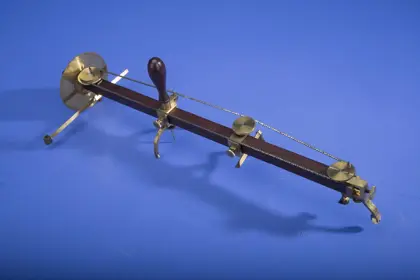 William W. Wythes Cyclo-Ellipto-Pantograph Patent Model
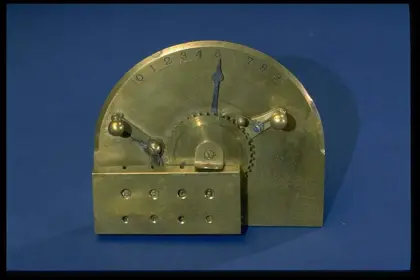 Baldwin Arithmometer
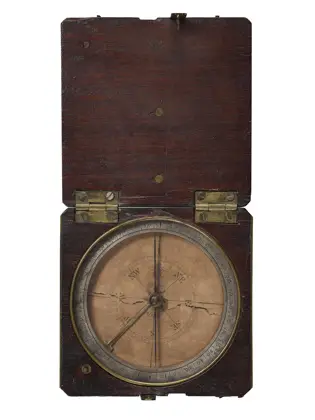 Pocket compass from the Lewis and Clark Expedition, 1804-1806
 Surveyor's Vernier Compass
 polariscope
Also answering “How much?” see all
 Grunow Spherometer
 Hatfield Machine for Adding Numbers
 Hill Arithmometer
 Burns Addometer
 Rotating Mathematical Table, Sinclair's Freight Computer
 Barbour Calculating Machine ModelBaldwin Arithmometer
 Patent Model for Estimator Slide Rule Invented by Fredric Maurice Stapff
 Barbour Calculating Machine
 Baldwin Calculating Engine
 Log and Rotor, Patent Model
 Thomas Arithmometer