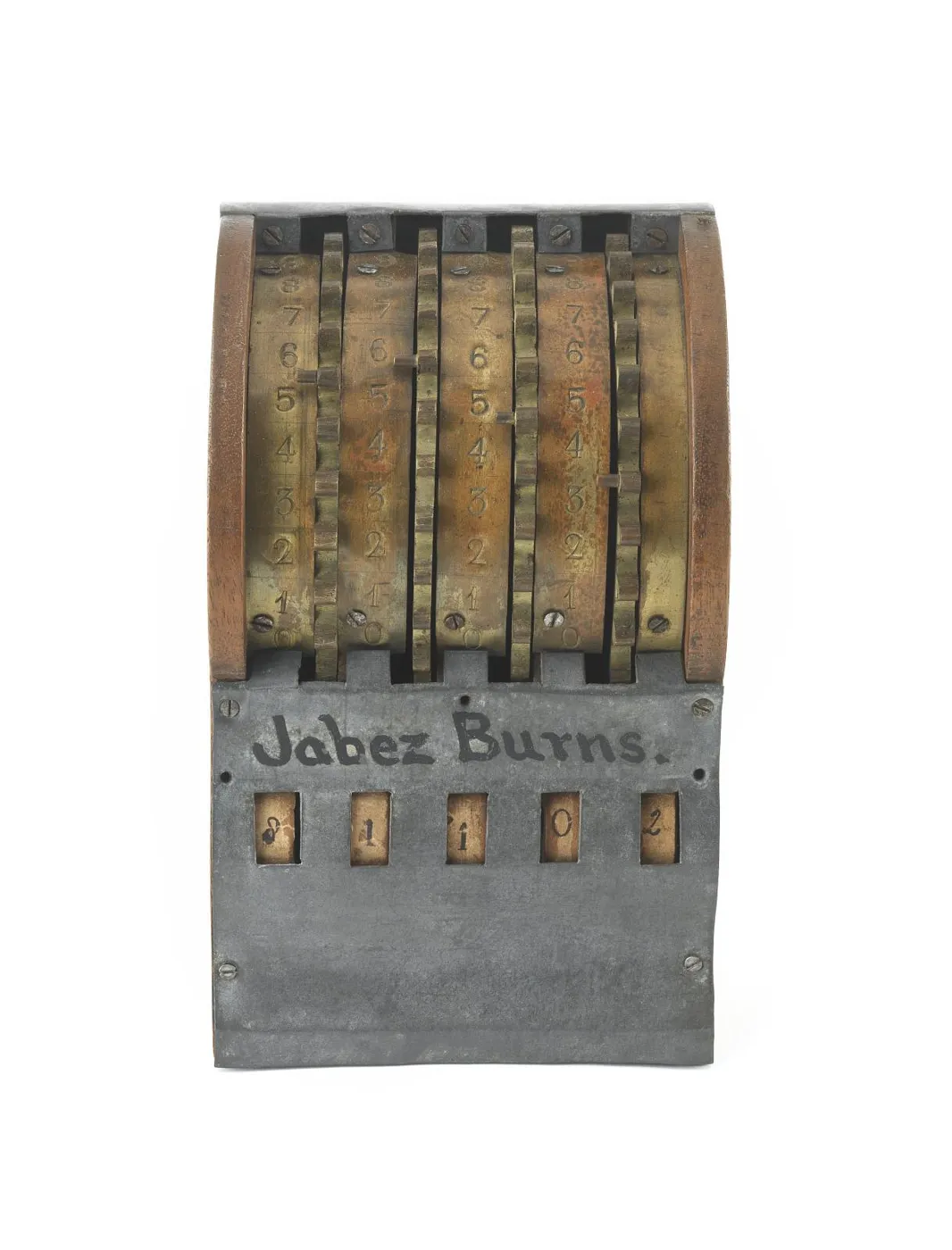
Burns Addometer
Setting numbers on its toothed wheels added them up, and the answer showed in small windows.
- Date
- 1858
- Maker
- Jabez Burns
- Place
- United States: New York, New York City
- Dimensions
- overall: 16 cm x 38.7 cm x 12.2 cm; 6 5/16 in x 15 1/4 in x 4 13/16 in
- Museum
- National Museum of American History
This U.S. patent model for a lever-set non-printing adding machine has wooden sides and metal covers for the back and the lower front. Four large toothed wheels are used for setting numbers, with five registering wheels in front and below these. Between each of the large wheels is a strip of metal; the digits from 0 to 9 are indicated along the edges of these strips. Each of the four right registering wheels is attached to a spur wheel with ten teeth that meshes with a large toothed wheel. Placing a finger in one of the teeth of a large wheel and rotating it forward advances the registering wheel proportionally. The number entered is visible in a row of windows at the front of the model. The four registering wheels to the left have on their left side a ring of ten equidistant pins that are used in carrying.
The patent tag for the machine reads: 21243 (/) J. Burns (/) Addometer (/) Patented Aug 24 (/) 1858 (/) Calculator.
On March 26, 1867, Jabez Burns of New York City took out U.S. Patent 52934 for an improved powder mixer. The model for this patent is in the Medical Sciences collection of the Smithsonian’s National Museum of American History. It seems likely that this is the same person who invented the addometer and the same Jabez Burns who was born in Ireland in about 1827, came to new York at age 18 in January of 1845, and worked variously as a cartman, peddler, accountant, and inventor. He had a son, also called Jabez Burns.
References:
Jabez Burns, "Addometer," U.S. Patent 21243, August 24, 1858.
U.S. Census records 1850, 1860. Civil War draft regisration records, June, 1863. New York City directories.
The museum's own record (Smithsonian, National Museum of American History)
Also made in New York City see all
 Sextant
 Grunow Spherometer
 Spectroscope
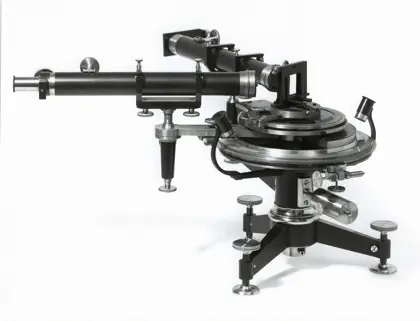 Spectrometer
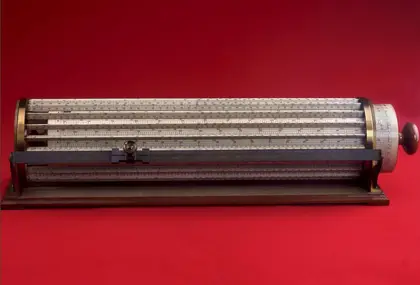 Keuffel & Esser 1741 Thacher Cylindrical Slide Rule
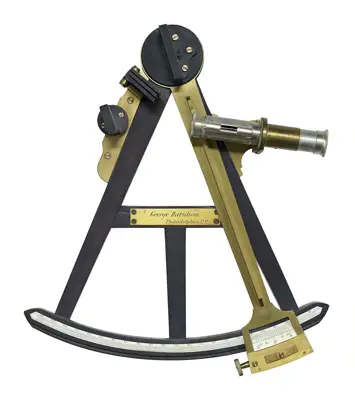 Octant
Also answering “How much?” see all
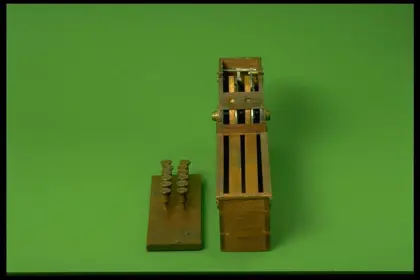 Hill Arithmometer
 Hatfield Machine for Adding Numbers
 Patent Model for Circular Slide Rule Invented by John W. NystromGrunow Spherometer
 Rotating Mathematical Table, Sinclair's Freight Computer
 Barbour Calculating Machine Model
 Baldwin Arithmometer
 Patent Model for Estimator Slide Rule Invented by Fredric Maurice Stapff
 Barbour Calculating Machine
 Baldwin Calculating Engine
 Log and Rotor, Patent Model
 Patent Model for Simplex Slide Rule Clasp Invented by Rudolph C. Smith