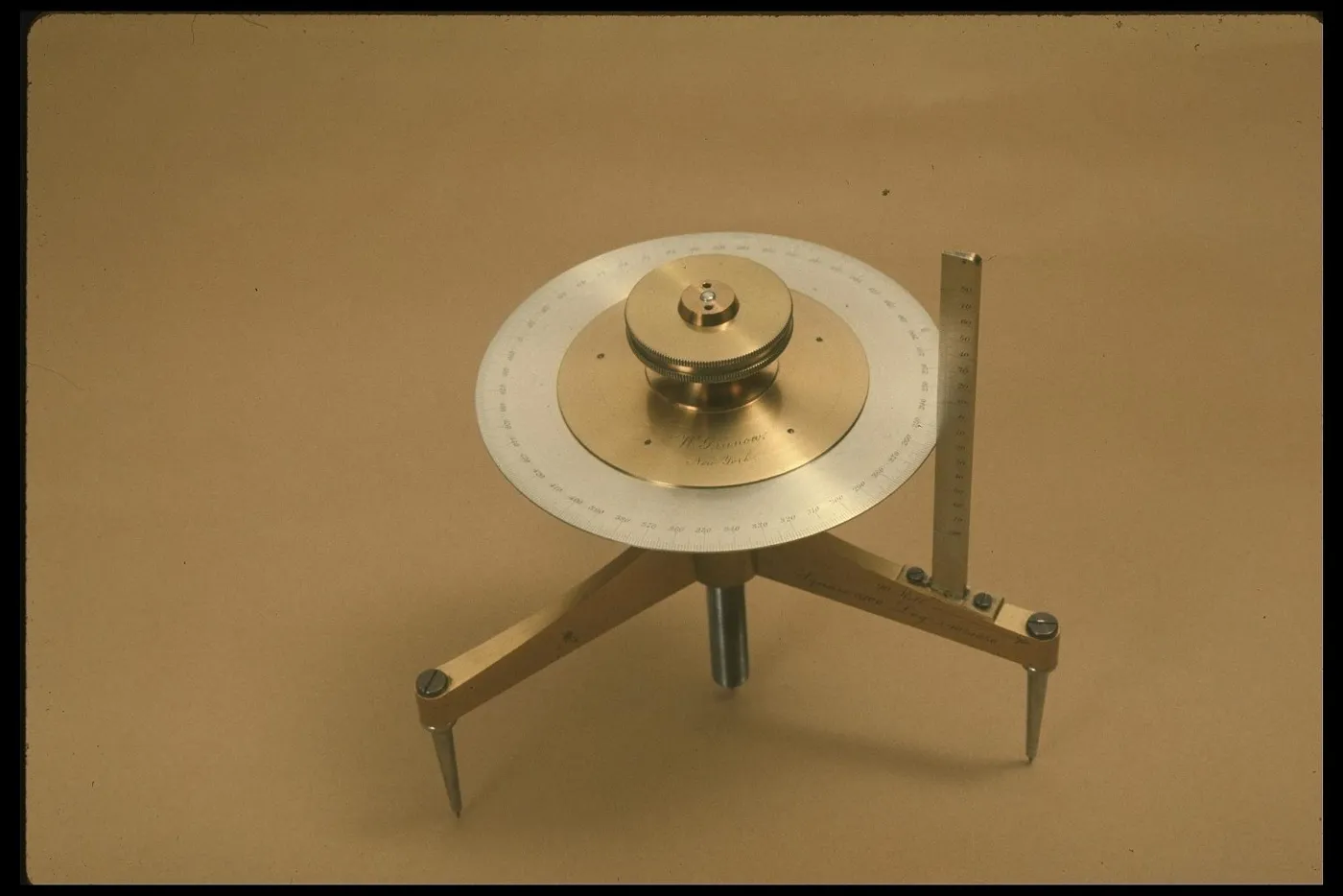
Grunow Spherometer
Three fixed legs and a center screw measured how much a lens or mirror curves, to a tiny fraction of an inch.
- Date
- after 1849
- Maker
- William Grunow
- Place
- United States: New York, New York City
- Dimensions
- overall: 18 cm x 16 cm x 16 cm; 7 3/32 in x 6 5/16 in x 6 5/16 in
- Museum
- National Museum of American History
- Credit line
- Department of Physics and Chemistry, Unite States Military Academy at West Point
A spherometer is a device used primarily for measuring the curvature of objects such as lenses and curved mirrors. They were produced from the 18th to the early 20th centuries, for use by astronomers and opticians and are still mentioned on websites today. The spherometer is a micrometer comprised of three legs that define a plane. A central point can be raised or lowered to just touch the surface. The distance this central point is above or below the flat plane made by the three legs is read off the vertical scale on the device. This distance is then translated into a number that describes the radius of curvature of the surface. Spherometers can also be used to measure the thickness of a flat plate or the amount a flat surface deviates from being truly flat. (See the introduction to the spherometers for the details of the uses and mathematics of this device.)
This spherometer was produced in the mid-19th century by William Grunow, a German immigrant and instrument maker living in West Point, New York. William and his brother Julius immigrated to New York in 1849. They began making microscopes while William produced other instruments, such as the spherometer under the marking “Wm. Grunlow, New York.” This spherometer was owned by the Department of Physics and Chemistry at the United States Military Academy, West Point, New York and transferred to the Smithsonian in 1958.
References:
Mills, A. “The Spherometer,” eRittenhouse 24, no. 1 (2012/2013).
Warner, D.J., “Spherometer,” Instruments of Science: An Historical Encyclopedia (1998): 569-570.
The museum's own record (Smithsonian, National Museum of American History)
Also by William Grunow see all
Also made in New York City see all
 Sextant
 Burns Addometer
 Spectroscope
 Spectrometer
 Keuffel & Esser 1741 Thacher Cylindrical Slide Rule
 Octant
Also answering “How much?” see all
 Patent Model for Circular Slide Rule Invented by John W. Nystrom
 Hatfield Machine for Adding Numbers
 Hill ArithmometerBurns Addometer
 Rotating Mathematical Table, Sinclair's Freight Computer
 Barbour Calculating Machine Model
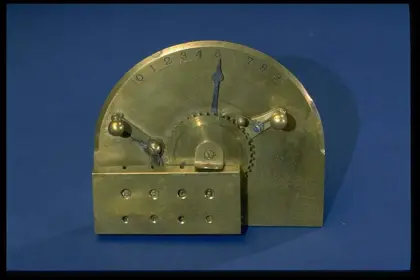 Baldwin Arithmometer
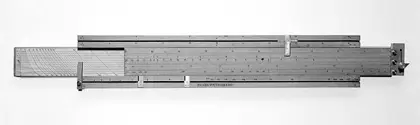 Patent Model for Estimator Slide Rule Invented by Fredric Maurice Stapff
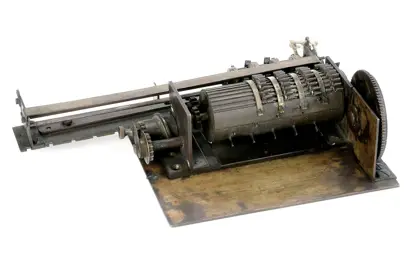 Barbour Calculating Machine
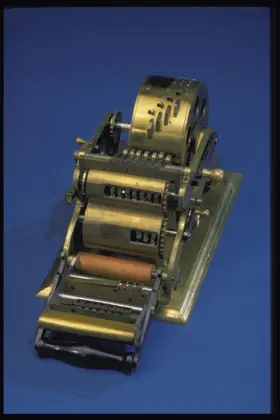 Baldwin Calculating Engine
 Thomas Arithmometer
 Log and Rotor, Patent Model