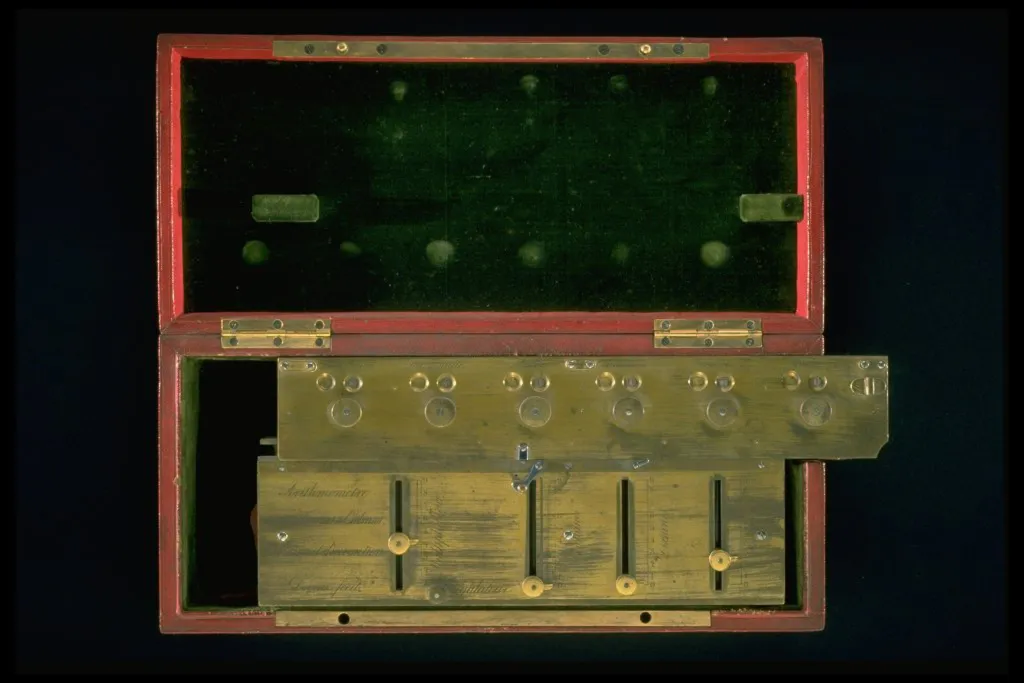
Thomas Arithmometer
Turning a crank and setting dials multiplied and divided numbers, saving clerks from doing the long arithmetic by hand.
- Date
- ca 1820
- Maker
- Charles Xavier Thomas
- Place
- France: Île-de-France, Paris
- Materials
- brass (overall material); leather (case material); velvet (case material); wood (case material); ribbon (case material); ribbon (mechanism material)
- Dimensions
- overall: 8.2 cm x 29.5 cm x 13.4 cm; 3 7/32 in x 11 5/8 in x 5 9/32 in
- Museum
- National Museum of American History
This is the oldest surviving example of the type of stepped drum calculating machine constructed under patents obtained by the Frenchman Charles Xavier Thomas of the French town of Colmar in 1820. Machines that could do arithmetic automatically were built as mechanical marvels in the 1600s on the design of mathematicians such as Blaise Pascal and Gottfried Leibniz. However, it was only with the introduction and improvement of the machine of Thomas that calculating machines became part of the world of practical calculation. The instrument was made for Thomas by the Parisian mechanician and clockmaker Devrine. Thomas arithmometers, as the machines were called, became the first commercially successful calculating machines.
The brass machine fits snugly in a wooden case covered with red shagreen and lined with green fabric intended to look like velvet - the fabric may be a synthetic fiber. It has three levers that are moved back to enter digits on brass stepped drums. A fourth lever, to the left of these, is labeled Multiplication, and used to determine the number of times the stepped drums rotate. Hence in this early machine, Thomas attempted direct multiplication by a single digit. This feature would not be successfully used in calculating machines until the late 19th century.
In back of the digit levers is a movable carriage with a row of six pairs of windows. Beneath each pair is a button. The levers are labeled: Unités, Dixaines, and Centaines. The pairs of windows are labeled: Unité, Dixaine, Centaine, Mille, Dix Mille, and Cent Mille.
Beneath each window is a numeral wheel. Two sets of digits are marked on each wheel, one in black and the other in red. Shifting a lever on the right of the carriage to “add e multiplication” opens six windows to show in black digits the result of addition and multiplication problems. In the other positions, six windows open to show in red digits the result of division and subtraction problems. Beneath the windows are thumbscrews for zeroing the result digits one at a time. There is no revolution register.
Pulling a red ribbon operates the machine. Pulling a shorter ribbon attached to the front assists in removing it from the case. Later Thomas machines would be crank-operated. The lid of the case has a brass handle, lock, and key. Part of the right side of the case turns down to allow for the motion of the carriage.
A mark on the left of the levers reads: Arithmomètre (/) du Chr. Thomas de Colmar (/) Par Brevet d’invention (/) Devrine fecit. A mark on a button at the front of the machine reads: Régulateur. A mark on the top of the lid reads: ARITHMOMÊTRE (/) De MR. LE CHER THOMAS DE COLMAR.
The machine is not identical to that shown in the drawings of Thomas’s 1820 patent. It resembles the drawings made in 1821 for a report by Hoyau published in 1822.
References:
Stephen Johnson, “Making the Arithmometer Count,” Bulletin of the Scientific Instrument Society, No. 52, 1997, 12–21.
“Rapport fait par M. Francoueur. . .,” Bulletin de la Société d'Encouragement pour l’Industrie Nationale, 21, 1822, pp. 33–36.
Charles-Xavier Thomas, “1420,” 18 Novembre 1820. This is the number of Thomas’s 1820 French patent.
Hoyau, “Description d’une machine à calculer nommée Arithmomètre. . . ,” Bulletin de la Société d'Encouragement pour l’Industrie Nationale, 21, 1822, pp. 355–365.
The museum's own record (Smithsonian, National Museum of American History)
Also made in Paris see all
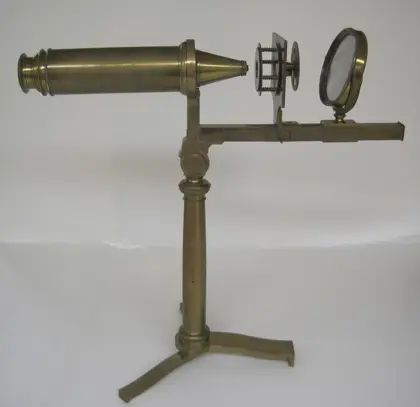 Microscope, Lerebours
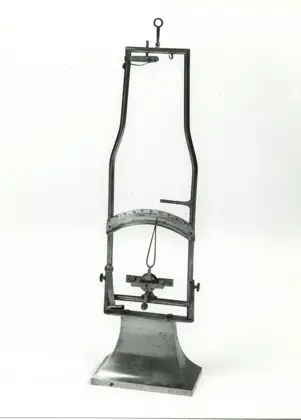 Hair Hygrometer
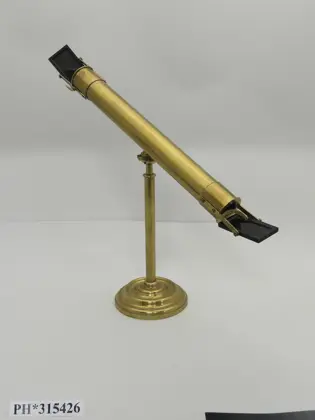 Polariscope
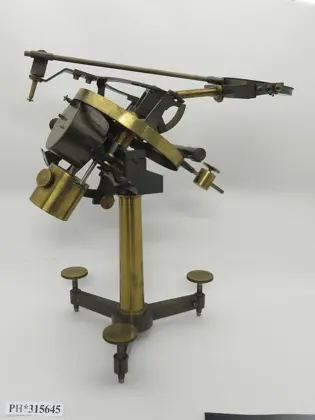 Heliostat
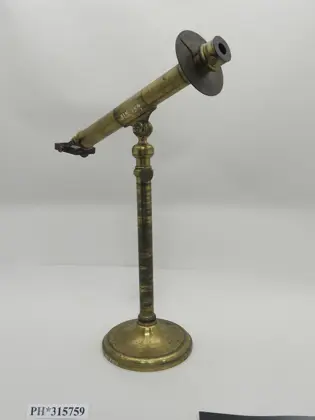 Polariscope
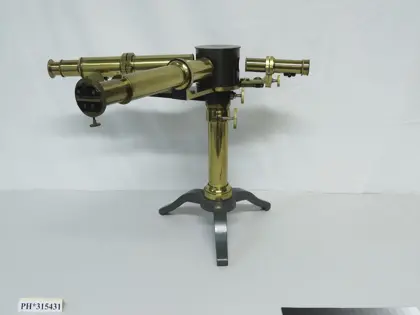 Spectroscope
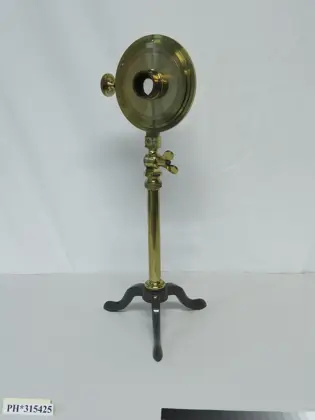 Jamin Apparatus
 Projection Polariscope
 Projection Polariscope
 Vibration Microscope
Also answering “How much?” see all
 Balance
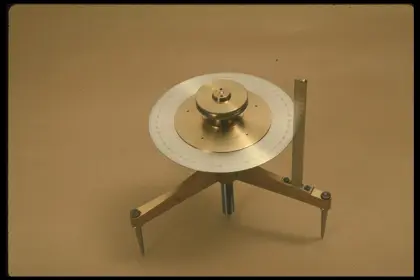 Grunow Spherometer
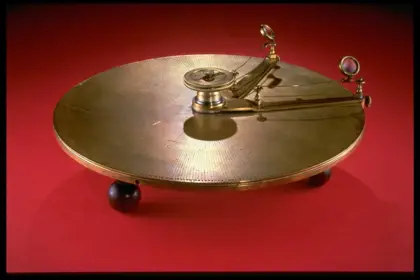 Patent Model for Circular Slide Rule Invented by John W. Nystrom
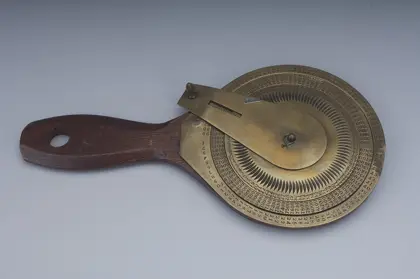 Hatfield Machine for Adding Numbers
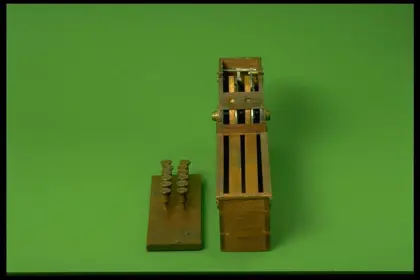 Hill Arithmometer
 Burns Addometer
 Beam Balance
 Rotating Mathematical Table, Sinclair's Freight Computer
 Barbour Calculating Machine Model
 Baldwin Arithmometer
 Patent Model for Estimator Slide Rule Invented by Fredric Maurice Stapff
 Barbour Calculating Machine